Wednesday, February 15, 2012

The Abominable Snowman (1957)


Cryptozoology ("the study of and search for animals and especially legendary animals [as Sasquatch] usually in order to evaluate the possibility of their existence," as defined by the Merriam-Webster online dictionary) is something which has fascinated me since I was a child. To be sure, it has fascinated legions of people over time. And yet, it is rarely the actual proving or disproving of a creature's existence which captivates our interest. No, it is the mystique of the unknown which rouses us and keeps us watching. The actual animals, once illuminated by the sterilizing light of day, become mundane, banal, taken for granted. But as long as they continue to elude us in the remotest parts of the world and the deepest, sodden depths and the farthest reaches of outer space (okay, extraterrestrials are not really considered cryptozoological, but work with me here), our minds will continue to dance with a million possibilities, and we will continue to be sated. Until new "evidence" rears its inevitable head, that is. 

Dr. John Rollason (Peter Cushing) is studying the mysterious medicinal plants harvested by the monks of a Tibetan monastery in the Himalayas. However, what John hasn't told anyone is he is waiting for Tom Friend (Forrest Tucker) and his party to arrive so they can head up the mountain. To everyone's disappointment, John and Friend are fixated on finding the legendary abominable snowman. As the expedition encroaches farther into the beasts' territory, the men begin to realize that the Yeti may be more than just an unthinking brute.

Of all the cryptozoologically-based films (Loch Ness Horror, Curse Of Bigfoot, Night Of The Demon, etcetera), Val Guest's The Abominable Snowman is without a doubt the best. It is distinguished from its brethren primarily by not being borne of exploitation. Certainly, it has elements of exploitation. The premise alone is testament to that fact. Yet, there's very little blood, no nudity, and a point to the film rather than just getting it up on theater screens. Interestingly, the same film studio that produced this film (Hammer) would, the very same year, add bright red blood and gobs of cleavage to their gothic horror films (beginning with Curse Of Frankenstein) and make themselves a household name (at least to fans of horror).

Hammer films always had an air of class to them, even in their later, more explicit fare. There was a high degree of production value onscreen, and the filmmakers were unafraid to take their time in telling their stories. It lent a traditional feel to films that had a more modern sensibility in terms of permissiveness. You almost felt like you were going to school when you watched a Hammer picture, only the instructor had rather large fangs. This film is no different. The widescreen frame is used in its entirety, and Guest moves the camera smoothly through the detailed sets, taking in everything it can. The cinematography by Arthur Grant is exquisite, with deep pools of black and three-dimensional lighting that distinguishes what could very easily have looked like a flat expanse of white. I would also like to mention here that there are a few lens flares in the film that instantly put me in mind of Dean Cundey's work with John Carpenter. Never a bad thing.

The film is concerned with an intellectual, rather than a visceral sense of horror. Screenwriter Nigel Kneale deserves the credit for this, I suspect. Known for the "Quatermass" series of films and television productions, Kneale's work has always looked beyond the surface of things and come up with new ways of seeing the world around us (yes, I own a copy of the Kneale biography, Into The Unknown, and no, I haven't had a chance to read it yet). Here, he posits the notion that the Yetis are not only a third branch of man's evolution (the "Missing Link" they've always been thought to be) but possibly a more advanced one which is hiding out in the hinterlands for a very specific reason. They also act as mythological sirens and banshees, calling out to lure men to their deaths and presaging their demise, though there's also a less paranormal explanation for this effect in the film. Nonetheless, according to John, the creatures' faces contain sadness, wisdom, and gentleness. Kneale's writing credits the viewer with a modicum of intelligence, and that's something I think viewers appreciate (usually).

The characters are fleshed out nicely, too. Friend is the ostensible villain, but he's not one-dimensional. He has goals and reasons for doing what he does. Taking the "ugly American" role, Tucker does an admirable job portraying a man driven by hard experience into making bad choices. John, by contrast, is not a lily-white hero figure, though he is more empathic (and empathetic) than the others. In the struggle of brain versus brawn, the survivors of the ordeal will be determined not by physical strength but by strength of character. And even then, there are no guarantees.

The filmmakers wisely keep the snowmen in shadows, only showing us an arm or eyes, just enough so we get the basic idea. To display the costumes in full would rob them of their enigmatic presence. They would be just guys in hairy costumes. Like Val Lewton very successfully proved earlier in films like The Cat People and The Leopard Man, the power of suggestion is worth more than any hundred effects shots, no matter how well-done. Allowing the viewer to complete the image in their own mind is, ironically, more potent than simply giving the audience what it thinks it wants. This is why the best performers and comedians live by the motto "always leave them wanting more." 

The Abominable Snowman also wisely uses three of Sir Arthur Thomas Quiller-Couch's seven basic conflicts: Man Against Man, Man Against Nature, and Man Against Himself. This, in and of itself is not particularly noteworthy, but in this film the conflicts are all taking place at the same time to the same people. It's not just John trying to stop Friend from attacking what he shouldn't. But he has to do this while surviving blizzard conditions and unknown creatures and also struggling with his own reasons for being there. It provides a richer, more satisfying story than any one conflict or crosscutting between conflicts could. 

When all is said and done, the filmmakers may not have crafted the single greatest or scariest movie ever. But they did create (in my opinion, anyway) the greatest Bigfoot movie ever. And you should do yourself the favor of tracking this one down.

MVT: It really is a toss-up between Cushing and Kneale (though, honestly, both Guest and Grant could just as easily be included in this melee). However, since the likelihood of me covering another Cushing film is higher than another Kneale film (but one never knows), I'll go with Mr. Kneale on this one. If you've never seen anything written by this man, you're in for a treat.

Make Or Break: The first night shot on the mountain is absolutely stunning. There's a heavy fog that blankets the set in strata, the characters are nothing more than silhouettes, and it is damn near a perfect cinematographic composition, to my eyes. 

Score: 7.5/10

(Like this review?  Share it with a friend.  Hate it?  Share it with an enemy.  It's win-win!)

Tuesday, February 14, 2012

DVD/Blu-Ray Picks Of The Week - 2/14/12

Large William's Pick: ELITE SQUAD: THE ENEMY WITHIN (Region 1 DVD & Blu-Ray; New Video)
Although there are several great options this week, I have to go with this Brazilian powerhouse. For the uninitiated, the 2 Elite Squad films focus on the BOPE task force in Brazil. Truly one of the most rugged, hardcore tactical units on the planet. Focusing on interwoven characters and themes, specifically corruption and how pervasive it is throughout Brazil, this certainly is a sequel well worth everyone's time. Written by the same scribe as City of God, those familiar with that film, can expect the same style, quality, and effortless density with this seriously great duo of films.

Kisses,
Will

P.S I have a man crush on Werner Maura

Links:
Amazon Blu-Ray and DVD
Blu-Ray.com Review

Sammy's Pick: THREE OUTLAW SAMURAI Region 1 Blu-Ray; Criterion)
No Questions. Just Buy.

Links:
Amazon Blu-Ray and DVD
BoulevardMovies.com - Blu-Ray and DVD
Blu-Ray.com Review
High-Def Digest Review

Monday, February 13, 2012

Episode #171: Bamboo Express

Welcome to possibly the sleaziest episode we have ever produced....maybe?

The GGtMC is back and this week we bring treasure in coverage of Bamboo House of Dolls (1973) directed by Chih-Hung Kuei and Terror Express (1979) directed by Ferdinando Baldi and written by the Immortal George Eastman.

We have said some tasteless things in our day but we have the spirit rolling in this episode, hope you guys have fun because we had a blast!!!

Direct download: Bamboo_ExpressRM.mp3

Voicemails to 206-666-5207

Emails to midnitecinema@gmail.com

Adios!!!


Wednesday, February 8, 2012

The Great Texas Dynamite Chase (1976)


Technology has all but killed that age-old American tradition of bank robbing. Oh, sure, you can still rob a bank if you're of a mind to, but the planning needed to do so today falls this side short of just getting a job instead (that is, if you don't want to get caught). The security measures used in modern banks are so sophisticated, you could spend just as much on setting up the heist as you could make pulling it off. There have been timelock vaults for decades, but the intricacies and difficulty of actually getting one open have risen exponentially as the speed and complexity of technology has increased. Then there's the aspect of getting away with it, which if you wear a mask and don't leave your wallet behind (as an alarmingly high number of crooks seem to do), shouldn't be too hard, but the clarity of today's security cameras, the use of smaller and smaller tracking devices, ink packs, and so forth don't guarantee a clean getaway.

Candy (Claudia Jennings) has just escaped from prison with a few sticks of dynamite, to boot. Ellie-Jo (Jocelyn Jones) is a put-upon bank teller who has just been fired. When Candy shows up at Ellie-Jo's former employer's with a lit stick of said dynamite, Ellie-Jo feels a thrill she's been missing all her life and helps her rob the place. Having paid off the debt owed on the family farm, Candy takes it on the lam. After picking up the now-hitchhiking Ellie-Jo, the two determine that they make an okay team, and that robbing banks with dynamite instead of guns is a swell idea. Pretty soon, the duo's fame reaches a point where the authorities have to take them very seriously, indeed.

Michael Pressman's The Great Texas Dynamite Chase (aka Dynamite Women) is something of a mixed bag. It positions itself as a distaff Butch Cassidy & The Sundance Kid, but with cars and dynamite instead of horses and pistols. However, the pacing stops and starts depending on which of its two leads' turn it is to get naked (or even both at the same time). Granted, there's nothing inherently wrong with this, and it is certainly the main reason most people would want to see this film in the first place (the others came to see shit blow up). Producer Roger Corman's exploitation film strategy (boobs or blood every ten minutes) holds true, but there's little, if any, effort to work the exploitable elements into the story. Consequently, the film as a whole doesn't hold together too well. 

Also, the filmmakers seem unsure as to the tone of the film. It starts off as two girls having a good time robbing banks, but once the Fuzz bring shotguns to this dynamite fight, the mood sobers up for as long as it takes some bullets and blood to fly. I'll give you two examples to illustrate my point. There is an extensive undercranked shot of the robbers counting their loot, giving the goings-on a light, carefree feeling. Not long after, a character is rather messily shot and winds up floating in a lake. It's not so much the mood shifts that are an issue, but rather how they are handled. In my mind, undercranking has no place in any film that an audience is supposed to take even one iota seriously. If a technique was a staple of television sitcoms ("Gilligan's Island," I'm looking at you), it is disqualified from usage in non-comedic films. Likewise, graphic violence has no real place in a film intended as a light romp. That's just me. This is not to say a balance is impossible to strike. One's just not struck for the majority of this film.

This unevenness, then, applies to the film's treatment of authority figures. The first cop we see is overweight, rather dim-looking, and he hitches up his belt before approaching the crime scene. Plus, he is dumb enough to park over a lit stick of dynamite. Later, another cop is introduced reading a stroke mag on the side of the road. Pulling the ladies over, he tells the boys back at the station he's going to "get some piece o' ass." Needless to say, the girls make an ass out of him. A bank manager that the women robbed not once but twice is spoken of lowly by his unsuspecting wife and called a loser outright. Authority (and more so male authority) is depicted as clownlike. Even so, once the cops start showing up with rifles and hair triggers, all traces of buffoonery evaporate. It's all fun and games until someone loses an eye (or small intestine).

Still and all, the sexuality of Candy and Ellie-Jo is never portrayed as out of their control. They determine who they want to sleep with and when, and then they proceed to do so. Men who seek to force themselves on the duo are handily swept away. On this level at least, the film can be classified as feminist. The duo makes their own choices for their own reasons. They own their bodies and are the final deciders of what to do with them. In this sense, they are free, the whole reason for heading down their criminal path in the first place. And of course, a male-dominated society cannot bear the idea of independent women making them look bad, so they must be brought low by any means (read: violence) necessary.

To be fair, there are things in the film which are both interesting and entertaining. The first couple of times Candy and Ellie-Jo rob a bank are genuinely involving. There's some nice tension and uneasy comic mishaps (see, it's not impossible to do both), as well as an intriguing ploy which is at once wildly dangerous and thoroughly convincing in its effectiveness. Ellie-Jo's escalating search for thrills is also absorbing and provides an element of uncertainty and danger. Unfortunately, the filmmakers don't make an effort to build on these assets, and the viewer is left shrugging. That said, there is some very nice cinematography courtesy of Jamie Anderson (who would move on to the original Piranha and Grosse Pointe Blank), but it can really only elevate this material so much. 

So let's break it down, shall we? Yes, there is dynamite, and yes, it is set in Texas. There is some chasing whenever the story remembers it. But great? More like The Middling Texas Dynamite Chase. 

MVT: Whether she's brandishing TNT or prancing around in a pair of Daisy Dukes which could more aptly be described as a denim belt, Claudia Jennings is magnificent to watch whenever she's onscreen. And it's not just her looks. The woman had magnetism and talent in excess. Her death three short years later was truly a tragedy.

Make Or Break: The undercranked money-counting scene accentuates the uneven and dismissive feel of the film in toto.

Score: 6/10

Tuesday, February 7, 2012

Episode #170: Digging the Night Plumage

Welcome to the GGtMC!!!

This week we are sponsored by diabolikdvd.com and with the two selections we chose The Bird with the Crystal Plumage (1970) directed by Dario Argento, this is the Arrow Blu ray release. We are also covering Warner Archives The Night Digger (1971) directed by Alastair Reid.

We had to get creative this week with our recording, phones were used, pizzas were ordered...dogs were barking...it was chaos but it is the the GGtMC!!!

Direct download: Digging_the_Night_PlumageRM.mp3

Emails to midnitecinema@gmail.com

Voicemails to 206-666-5207

Adios!!!


Thursday, February 2, 2012

DVD/Blu-Ray Picks Of The Week - 1/31/12

Sammy's Pick: FERNANDO DI LEO CRIME COLLECTION (Region 1 Blu-Ray; Raro)
If you don't own it in some capacity your are missing out!!! I have seen the Blu Set and I have to admit it is a very nice upgrade....either way its a definite BUY!!!!

Large William's Pick: FERNANDO DI LEO CRIME COLLECTION (Region 1 Blu-Ray; Raro)
My pick is also the Di Leo collection. For all the reasons I mentioned when this set came out on DVD. We Euro-Crime fans are truly blessed to have as important and high quality a set as this on Blu. Sadly, there's a real lack of Euro-Crime on blu(much like DVD), so when a set like this comes out, we buy it. We need to encourage fine companies like Raro to have financial justification for doing great work like this. BUY. BUY. BUY. And besides, who doesn't want to see Silva's legendary yellow robe in Hi-Def?

Kisses,
William

Links:
Amazon
Diabolik DVD
BoulevardMovies.com

Wednesday, February 1, 2012

Jackson County Jail (1976)


In 1956, President Dwight D. Eisenhower signed the Federal Aid Highway Act into law, creating the Interstate Highway System (part of the National Highway System) we use (in America, obviously) to this day (and more often than not are inconvenienced by what we perceive to be the extremely inefficient and perpetual maintenance thereof). In post-WWII/Korean War America, more and more people opted to "See the U.S.A. in [Their] Chevrolet," and long-distance driving became something to do for reasons other than (primarily) shipping goods and mobilizing military assets from state to state. For fans of exploitation and genre cinema this opened up a whole new avenue to explore. For all the major metropolitan areas that these roads zip through, there are hundreds, if not thousands, of small towns which are inherently creepy (at least to people raised in more urban and suburban settings) for their insularity and remoteness. After all, not all monsters come with fangs and claws.

Dinah Hunter (Yvette Mimieux) is an ad executive in Los Angeles. After expressing herself forcefully to a (jackass of a) client over a feminine hygiene product ad, she goes home early. Upon arrival, she discovers her hubby, David (Howard Hesseman), screwing around with some teenie bopper. Deciding to head back to New York, Dinah chooses to drive rather than fly and "see the country" (never a good idea in exploitation movies). Through a series of despicable and harrowing events, she finds herself locked up in the eponymous jail where a final incident pushes her over the edge. Whisked away by aloof crook, Coley Blake (Tommy Lee Jones), looking like something Joan Crawford dug up out of a cave in England), the pair find themselves on the lam with no easy way out.

Michael Miller's Jackson County Jail, being attached as it is to Roger Corman, was sold to the American grindhouse circuit as an exploitation film. Though it does have some exploitable elements, the film is of a higher caliber than many similarly-themed films of the time (the first that springs to my mind is Black Mama, White Mama, but feel free to add your own). It has action and an aura of sleaze, but it never wallows in it, and the filmmakers create characters that behave (more) believably given the circumstances. Moreover, it doesn't dwell on the exploitable facets as so many of its brethren would. The filmmakers seem to care about what happens to these characters other than in a strictly prurient sense, and consequently so does the viewer.

This is Dinah's story, and principally it is one of discovery. When the film starts, she certainly has an opinion (and often a correct one), but the men she encounters undermine and devalue this opinion, trying to make her a subservient woman to their own chauvinistic needs and desires. Once the events in her life escalate, she finds herself robbed not only of her mind but her body, as well. Sheriff Dempsey (Severn Darden) sums it up succinctly when he tells Dinah that she's being held until she can prove who she says she is. 

It is through the juxtaposition of her words to her actions in the remainder of the film that Dinah's character should be revealed. And yet, somehow it never truly feels like it is. The filmmakers seemed to want to play it safe, with Dinah aligning herself with the outlaw Coley, but maintaining that she has faith that the system will vindicate her. Or perhaps this subversion of the expectation that Dinah must emerge from her ordeal a much stronger woman is, in fact, the whole point. Maybe she isn't a strong woman, and all of her actions and positions before were just posturing, a façade masking the true person.

Dinah Hunter's name can be seen as a variation on the Roman Diana, goddess of the hunt and protector of virgins and women. Dinah, herself, doesn't appear to be looked after by any divinity in particular, though the case can be made (and I can hear you groaning as I stretch for this one) that Coley represents Apollo, Diana's sister and god of (among other things) truth and prophecy. Jones plays Coley as stoic as stoic gets, saying things like, "I'll play what's dealt," and "I's born dead." He tries to show Dinah that there is really only one path open to her. Whether she accepts this by film's end is open to some debate.

On a filmmaking level, Miller displays a capable hand. He moves the camera when necessary and locks it down when appropriate. He also uses handheld techniques on four occasions (that I counted), and each time it succeeds in conveying the immediacy and tension required of the scenes. The first use is during Dinah's excursion into a bar's back room, and it conveys the chaos and confusion of her character right up until she exits into the main bar room (and assumed safety). The second use is during Dinah's rape, and there is an abundance of closeups and extreme closeups to draw us in and force us to witness the event but never in a leering, exploitive way. The shots immediately following the violation are longer, awkward, and uncomfortable, as befits the situation. The third and fourth handheld sequences focus on Coley and are action scenes to add thrills and tension, not necessarily to illustrate a point, but they are effective and well-done, nonetheless. The car chase scenes are also handled nicely, and there were a few points where I thought Coley's pickup was going to flip over (ah, the joys of practical filmmaking). To be fair, there are some continuity errors and gaffs (most noticeably with some mismatched eyelines), but it's never enough to detract from the experience overall.

The filmmakers also make a point of stating that the film takes place during America's (and the town of Fallsburg's, coincidentally) bicentennial celebration. This was a year for the country when national pride was at an all-time high, on the surface at least. But with the recent end of an enormously unpopular war in Vietnam and the Watergate scandal that ousted President Nixon from office, there came a strong distaste and distrust of public authority in general. Though it is never stated outright, it is easy to intuit that Coley was a soldier who returned from Vietnam to an uncaring country. He claims he has always been a crook, but he is also of the popular counterculture opinion that "the whole goddamn country is a ripoff." His nihilistic demeanor seems more a defensive reaction than an inborn credo, but we are never let in fully to his motivations. It is telling, then, that the film's finale occurs at a bicentennial parade, disrupting it and symbolically calling out a collective establishment that had become dismissive of its rank and file. Also of note is the expression on Dinah's face as the film fades to black. On one hand, the full impact of her life up to this point clarifies for her. Yet on the other hand, she glances around, seemingly confused about where to turn next. Certainly, this is a sentiment prescient for both its time and our own.

MVT: Mimieux carries the film, and I think she does a remarkable job portraying someone struggling to deal with the most traumatic events of her life and not truly knowing how.     

Make Or Break: The "Make" scene is when Coley tells Dinah that they're both now wanted for the events in the jail. The scene is understated, but places a very definite bit of punctuation on the ineluctable finality of the duo's fate.

Score: 7/10


Tuesday, January 31, 2012

Episode #169: Robbery 200

Welcome to another action packed episode of the GGtMC!!!

This week we welcome good friend of the show Tom, he donated to our program for Japan promotion we ran over the last year or so...and Tom picked a couple films that are real doozies!!! This week we cover Cargo 200 (2007) a Russian film from Aleksey Balabanov and Robbery (1967) directed by Peter Yates,

We had a great conversation and we go over just about everything you can possibly imagine, including some memorable if questionable nicknames for female genitalia....it just happen folks....

Direct download: Robbery_200RM.mp3

Emails to midnitecinema@gmail.com

Voicemails to 206-666-5207

Adios!!!


Sunday, January 29, 2012

Emily's 2011 Cinema Awards, Where Even Immortals Is a Winner

As I squeeze a few more watches into my life before publishing my official Top Ten of Eleven List, it seemed fitting to give some recent films their due in whatever format seems to fit. Expect lots of hyperboles!


Best Use of Headgear
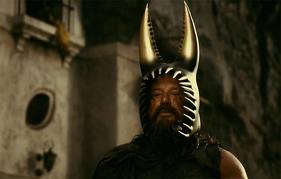
Immortals
Tarsem’s big budget Greekanization of 300
isn’t good by any means, but it was almost worth that escalated 3D ticket price to see Mickey Rourke sporting such accessories as this:


Peripheral vision be damned, now THAT'S a hat!


Best Film With a Theme I Despise And Thereby Don't Like the Film Even Though It’s Not So Terrible Itself

Melancholia
Lars Von Trier made a stunningly gorgeous and wonderfully acted end-of-the-world/wedding story. It just so happened he hates me for not hating the world that’s about to be destroyed, so I doubt he'll be invited to my birthday party this year. I guess I prefer my genital mutilation over clinical depression, but enough about ME...

Best Ending That Almost Saved a Disappointing Film


Black Death
From Creep to Severance to the kind-of mind-blowing Triangle, Christopher Smith has been making a steady upward crawl in genre filmmaking. With its medieval setting and impressive cast, Black Death was primed to be something special but seems to fizzle out once the excitement of the bubonic plague wears off. What saves the film is its coda, a (SPOILER ALERT) deeply dark finish that sees its innocent monk-in-the-making protagonist transform into a cruel witch hunter worthy of The Devils. It’s almost as if the whole movie becomes a prequel to that torture-filled subgenre of the 60s and 70s.

Biggest Disappointment

Vanishing on 7th Street
Here’s a great idea: let’s start an apocalyptic thriller with a good premise and fantastically chilling opening sequence. Then let’s bore the pants off you for 80 minutes with a horrifically miscast batch of miserable people, and because that’s not enough, we won’t explain a single thing that happened in the dull mess of a movie you just watched. Oh Brad Anderson, you are a scamp.

Most Undisciplined Film


Super 8
But it’s nostalgic! Cried legions of fans of this film. Sure, it was, and that was fine. Heck, even the globby CGI monster that looked like an early draft of Cloverfield’s star didn’t bother me too much. My issue with Super 8—and perhaps main reason I loved Attack the Block as much as I did—was that the film didn’t understand its own point of view. Had the whole story been told from the kids’ eyes, Super 8 would have soared, especially if its nearly 2 hour running length was shaved. The alternative could have also worked: give us an EPIC alien invasion film that incorporated the scientists’ findings and adult reactions more organically. Instead, J.J. Abrahms saw fit to combine its Stand By Me-like youth point of view with a lazy, occasionally trailing of Kyle Chandler’s sheriff as he learns some things that our main protagonists never do. As a result, whose film is it?
 
Best Sequel


Final Destination 5
Was it The Godfather Part II? No, but did The Godfather Part II have a death-by-parallel-bars back break? Final Destination 5 was an unpretentious injection of horror fun, an enjoyable 90 minutes of intricate murder wrapped up inside a film that actually cared about its franchise’s audience, rewarding the faithful with a brilliant ending that only the loyal would get.


Best Movie To Watch Plastered On Your Birthday


The Roommate
I remember virtually nothing of this tepid Single White Female wannabe, both because it’s so dull it barely casts a shadow and I went to see it with a lot of alcohol in my system. If memory serves, Billy Zane wears a hat, a hat that Mickey Rourke's hat could eat, vomit, inject with life serum, and watch that reanimated hat make a more interesting film than The Roommate.


Best Sound

The Last Circus
Here was a film seemingly scripted and produced for someone like me: surreal circus violence and a killer clown? Sign me up! Sadly Alex de la Iglesia’s Spanish Civil War metaphor coated in pancake makeup felt a tad empty to me, but when backs snap and faces get ironed, your ears experience something very, very new.

Best Lack of An Accent


Season of the Witch
Could you envision a table reading where Ron Perlman and Nicolas Cage toyed with British accents, then director Domonic Sena watched Robin Hood: Prince of Thieves and realized that only VILLAINS in period films needed them? Yeah, I'm assuming that's what went down and thankfully, we're all the better for it.


Torture Device of the Year


Brazen Bull
Immortals burned a few pretty oracles inside one and Gary Oldman lorded over it in elephant form in the already-hysterical Red Riding Hood. Who knew the biggest trend of 2011 would be so...brass?

Most Effort Put Into Films That Weren’t That Good


Rubber/Dylan Dog: Dead of Night
It’s a tiring tie between the look-at-how-weird-I-am Rubber and the laugh-at-me-PLEASE Dylan Dog: Dead of Night. With its aggressively avante garde approach, Rubber goes flat (damn you easiness of tire puns) on the screen because as good an idea as using a ridiculous premise to craft a film about voyeurism is, the movie simply is not, primarily because it clearly THINKS it is and...well, you get the point. That might not have made sense, but neither did the film. Dylan Dog, on the other hand, tries harder than Anne Hathaway at the Oscars to endear itself to the absent audience, forcing awkward banter between Brandon Routh’s wooden private eye and his former Superman costar’s ‘wacky’ zombie. You almost feel bad for it. Unless you paid, and then it’s not funny to anyone.

Best Construction of a Sequel


REC 2
Yes, it was technically a 2010 release, but when non-illegal means or film critic badges mean lowly movie fans like us can only see it in 2011, I consider it 2011. REC 2 didn’t grab me with quite the same urgency as its predecessor, but it’s hard not to admire how well REC 2 works in terms of its series, picking up the found footage narrative without feeling contrived.

Most Anticlimactic Death


Harry Potter & the Deathly Hollows: Part Deux
Having thus far only read the first book, I understand that there are some character nuances I have yet to experience simply by watching the films. That being said, one of the best villains in this film franchise is Helena Bonham Carter’s cackling Beatrix LeStrange, an evil witch who brings to mind what was good about Tim Burton before, well, he married Carter and got stuck in time. Thus, seeing a likable but minor character (Ron’s mum) finish her off with a quick spell and a line curbed from Aliens just felt anticlimactic.


Best Scene Stealer


William Finchter, Drive Angry 3D
How exactly does one hijack a movie from Nicolas Cage? One be William Finchter's ambiquous Accountant, that's how.

Best Film Without a Genre


Take Shelter
I've read rumblings of how Jeff Nichols' quiet study of schizophrenia/the apocalypse/Michael Shannon's awesomeness was likely ignored by major film awards because of its oddness or even, dare I say it, categorization as horror. In no way does the film belong on the same shelf as Paranormal Activity, but it IS horrifying, much in the same way as something like Todd Haynes' Safe or Michael Tolkin's The Rapture. But for some, the apocalyptic undertones relegate Take Shelter out of the pure and prestigious 'drama' club, making this haunting--and duh, incredibly acted--tale a movie without a home...or shelter.

Frank Oz Is An Asshole Award


...For his grumpy Stadler and Waldorff-esque trash-talking of The Muppets before its release. Look, it's not Jason Segel's fault that your last film managed to poop on the talents of Bette Midler, Nicole Kidman, Nathan Lane, Jon Lovitz, and the original near-perfection of Bryan Forbes' The Stepford Wives. Trust me, that film was far more offensive than Fozzie's fart shoes.

Movie I'm Appreciative Exists. Now Go Away


Chillerama
I love the spirit behind this film, a four-part anthology made by four hard-working and creative directors with a clear affection for genre history. But twenty minutes of semen jokes, another twenty minutes of werebear singing, another twenty of a Hitler gag that was funny for fifteen, and an endless repeat of movie quotes in the finale is a whole lot of wasted time.

Best Random Homages

Hobo With a Shotgun/YellowBrickRoad
In the 21sst century, we can safely assume that any working filmmaker has seen a lot of movies. It's common practice to reference the ones with influence, be that visually or in dialogue. This year, there were two films that did this to outstanding effect: Hobo With a Shotgun for its affectionate embrace of all the colorful hues and homeless politics of 1986's Street Trash, and the sharp direct-to-DVD YellowBrickRoad, which used one of the most beloved classics of all time as a maddening inspiration for some fantastic scares.

Needs More Dinosaurs Award


Tree of Life
Because c’mon! What’s more accessible than dinosaurs? Do you KNOW how many Land Before Time sequels have been made?


Wednesday, January 25, 2012

Baba Yaga (1973)

In Slavic folklore, the Baba Yaga is a nasty-looking witch who flies around in a giant pestle. She absconds with and eats children. She lives in a shack built on top of giant chicken legs that can move it around as it needs. Despite the ridiculousness of some of her trappings, the Baba Yaga is quite a creepy mythological figure. Think about it. A cackling (I assume she's a cackler) hag flying at you from out of the darkness in a giant ceramics project. And you can just see her moving all jittery, like a possessed character in a Sam Raimi movie, can't you? Historically, she often must be sought out for some piece of information or item which a story's hero or heroine needs to accomplish his/her quest. That Baba Yaga does not make an appearance in Corrado Farina's Baba Yaga.

Valentina (Isabelle De Funès) is a perky, flirty fashion photographer living in Venice (Italy, not California). Her quasi-beau, Arno (George Eastman), keeps trying to get into Valentina's bed, lamenting that he doesn't know if he'll "ever be ready for that chick." After a Eurotrash-populated party, Valentina rescues a dog from an oncoming car. The car's driver, Baba Yaga (Carroll Baker), gives Valentina a ride home (we never find out what happened to the dog) and snatches a clip from Valentina's garter belt, saying she will return it after checking if Valentina fits her needs. Quickly thereafter, Valentina finds that she may be unwittingly harming the people around her, as she herself is being pulled into a role which will bind her forever to the enigmatic blond witch.

Baba Yaga's intent is plain from her first meeting with Valentina. She means to have the photographer whether Valentina likes it or not. While Baba says that their initial meeting was preordained, it doesn't necessarily guarantee their eventual ending. What I found interesting in Baker's performance here was the aggressiveness on display. Whenever she appears she can be seen biting on something (the garter belt clip, a necklace, her own knuckle). This constant baring of teeth is a display of fierceness as well as being a statement of intent (though not in an anthropophagic sense). Baba makes no bones about it. She wants Valentina, and she will let nothing stand in the way of her goal. The idea of a stranger, especially one as odd as Baba showing up out of the blue and announcing that she's going to have you is at once scary and seductive. It is doubly so when you introduce the overt Sapphic connotations. The allure of the unknown in this respect is both horrifying and enticing, especially considering that giving into this particular temptation also forfeits one's freedom.

Baba's seduction of Valentina, then, can be seen as a possible release from repression. From the start, Valentina goes out of her way to display her independence, refusing a ride home from Arno, declining to invite Arno up to her apartment, and so on. Is this because she secretly has these urges she would rather not acknowledge? Or is it because she feels that by being so fiercely self-reliant outwardly, she can maintain control of her life and her body? This freedom from repression can be either a boon or a bane. Sometimes it creates the link needed to make a character whole (or at least a springboard from which the rest of their life can now progress). Sometimes it only speeds up a character's ultimate destruction. It is the tension created by this internal struggle that propels the film forward and gives the viewer so much to consider along the way. This also takes into account the equating of sex with power in a relationship. Baba Yaga's assaultive drive to have Valentina's body is juxtaposed with Valentina's more benevolent teasing out of Arno's expectations, but it is no less powerful. Just because the prey allows itself to be caught doesn't mean that the predator is the victor.

(The following paragraph will probably offend any psychologists reading – you have my apologies in advance) Baba Yaga is an adaptation of a comic book by artist Guido Crepax, whose work is informed and inspired by the concepts of psychoanalysis. In a Freudian sense, the very ideas of homosexuality and bondage/sadomasochism and their practitioners are considered perversions. Ergo, Baba Yaga can be seen as an aberrant character, and Valentina's quasi-attraction to her as equally off-key. But in a Jungian sense, neurosis is brought about because "rationalism…has put (modern man) at the mercy of the psychic 'underworld'." It is interesting, therefore, that Baba Yaga is depicted as being pallid, almost colorless, as if she sprang out of the seemingly-bottomless pit in her house (which is also seen in Valentina's dreams tellingly before finding it in Baba's place). She comes from the underworld (or an underworld, anyway), and she wants to drag Valentina back there with her (by the hair, I'm thinking).

There are multiple nods to the film's origins, as well as juxtapositions of film to comic books throughout the piece. When Valentina and Arno are looking at a graphic novel, the drawn images are replaced by monochromatic photos of the film's characters, as if they are captured in the comic's panels. However, the panels progress and intercut with live-action, making the statement that both forms are merely a collection of still images. It is film's flicker fusion that provides the illusion of action and movement. Yet, both forms draw the eye where they want to through shot choice, composition, lighting, and so on. They both control the pace of storytelling through the duration of their "shots" and scenes. Smaller panels in a comic propel action forward faster than large ones, and it's the same with a film's shot duration and editing. This device is used at multiple times in the film and provides a running motif. There is also the recurrence of Valentina's flashbacks occurring in quick shots (sometimes live-action, sometimes fumetti), furthering the idea of comic book panels on film, as well as illustrating Valentina's mind for the viewer.

Baba Yaga curses Valentina's favorite camera, calling it "the eye that freezes reality." This camera then becomes a force of destruction to things in motion. Valentina's career as a photographer is another signifier of the power of one moment in time, as well as the thin veil of perceived reality (she shoots magazine ads). Contrasted with Arno's work in the commercial film industry (also a creator of advertisements), Valentina's camera has the power to destroy the moving image, to force it back into a collection of stills.

This manipulation of reality extends into (and out of) Valentina's dreamworld. She dreams of being brought before a Nazi officer (by two female Nazi soldiers) and dropped into a bottomless pit. The pit will later be found in Baba's house. Later, she dreams that she is a Prussian soldier firing at a friend and colleague of hers who was hurt by the cursed camera. Baba's servant appears and makes off with Valentina's camera in a dream. Upon waking, the camera is gone. What the viewer is ultimately left with is a world in which Valentina is not only occupant but creator (either consciously or unconsciously), and simultaneously neither, because the work is orchestrated by Crepax, but in this version it is also orchestrated by Farina. Consequently, it exists, as do the characters, on multiple planes of existence, all of them fascinating to consider in their neverending dance.

MVT: Crepax's original work (which, incidentally, I have not had the pleasure of reading) is strong enough to translate into a film that, while not perfect, leaves a lot to ponder.

Make Or Break: The style and themes of the piece are both jelled and encapsulated by the scene of Valentina and Arno in Valentina's apartment.

Score: 7.25/10

Tuesday, January 24, 2012

DVD/Blu-Ray Picks Of The Week - 1/24/12

Sammy's Pick: GODZILLA (Region 1 Blu-Ray & DVD; Criterion)
It's the Criterion treatment for the only honestly solid Godzilla movie in my opinion. I know there are people that like them all, but this is truly a film to me whereas the others are cashing in more on the novelty. I am honestly picking this because I feel more films like Godzilla DESERVE the Criterion treatment and we as film fans need to support this title!!!

Links:
Amazon Blu-Ray and DVD
Diabolik DVD and Blu-Ray
BoulevardMovies.com Blu-Ray and DVD
Blu-Ray.com Review

Large William's Pick: LETHAL LADIES COLLECTION 2 - Roger Corman's Cult Classics Collection (Region 1 DVD; Shout! Factory)
This is an absolutely fantastic value pack; we've got 3 great exploitation films from the early to mid 1970's directed by genre stalwarts(and personal favorites) Cirio Santiago, and a Joe D'Amato/Steve Carver film that has been out of print FOREVER, that I've wanted to own a proper copy of. The 2 Santiago helmed films are Fly Me(1973), and Cover Girl Models. Both feature some fun 70's action, lots of naked 70's foxes and the pace that anyone who digs Santiago's films has come to trust. The third film stars none other than the Matron Saint of the GGtMC, Pam Grier re-teamed with her Black Mama, White Mama co-star, Margaret Markov, not to mention Lucretia Love, and one on my all time favorite Euro babes, Rsalba Neri. It's co-directed by Steve Carver(of Lone Wolf McQuade fame) and Joe D'Amato(of every sleazy as fuck George Eastman penned romp from Italy in the mid to late 70's). All of these for under $20 gang. It's a S-T-E-A-L, and worth every dime!

kisses,
William

Links:
Amazon
Diabolik DVD
BoulevardMovies.com

Aaron's Pick: FASCINATION (Region 1 Blu-Ray & DVD; Redemption/Kino)
The works of the late French filmmaker Jean Rollin can be hit or miss with me, but FASCINATION - an atmospheric unconventional vampire film set in the French countryside - is one of my favorites of his that I've seen thus far. The folks over at Kino and Redemption have teamed up to restore a number of Rollins's films which are being released this week - some of which (including this film) are being made available on Blu-Ray for the very first time. If you're into erotic horror, lesbian vampires, atmospheric Gothic Horror films, and beautiful nude women wielding scythes, give FASCINATION a shot.

Links:
Amazon Blu-Ray and DVD
Diabiolik DVD and Blu-Ray
BoulveardMovies.com Blu-Ray and DVD