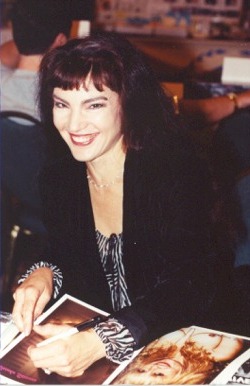
Rick Sloane is best known as the creator of the 1980's USA Network late night direct-to-video staple,
Vice Academy (1989) starring former adult film star Ginger Lynn and horror goddess Linnea Quigley. The film is a goofy comic strip of sexy big hair chicks bumbling their way through police academy training amidst internal cover-up and corruption. With the heavy rotation of the film on television in a now long gone
era, Sloane would go on to produce five sequels for the franchise to
date, and they've all been so successful that he now refers to his
Hollywood Hills home as "the house that
Vice Academy built."
There's a particular Ed Woodian bad movie aesthetic to the
Vice Academy series, but the films will leave you on the verge of a softie and heartily laughing as you swab your tongue in your cheek, as well as a sparked interest in Sloane's other work such as the Rick Sloane / Wings Hauser messy team-ups
Marked For Murder (1989) and
Mind, Body & Soul (1992). Or my personal favorite, the
Citizen Kane of stripper-on-the-run-for-a-crime-she-didn't-commit films
, Good Girls Don't (1993).
In addition, Sloane also directed the 28th worst film of all time according to IMDB,
Hobgoblins (1988). While
Hobgoblins has been slaughtered by critics and fans alike, it has shown incredible staying power and entered into cult film status over the last twenty years. As a follow-up, in 2009 Sloane directed
Hobgoblins 2 which instantly hit the internet for
download against the wishes of Sloane before it was officially released
on DVD, causing a legal stir which was promoted heavily by Sloane and the
mainstream media, opening up even wider the on going debate about the
potential damage digital downloads have on the artist. More on that
later.
Across the board, there is a wonderful blend of comedy, comic book, horror, and exploitation in the work of Rick Sloane that doesn't take itself very seriously, but where does it come from?
Sloane grew up in Hollywood, and as a teenager was obsessed with Roger Corman films and film-making. While still in his late teens, Sloane was offered a job working for 20th Century Fox marketing the horrible sequel to
The Rocky Horror Picture Show (1975),
Shock Treatment (1981). Sloane also owns one of the biggest Archie comic book collections on planet Earth. He's a self proclaimed Archie expert of sorts, contributing commentary to anything new being published on the classic comic character.
Regardless of Sloane's bad movie aesthetic, or any of his six cock teasing
Vice Academy films, Rick Sloane has influenced many. His
Vice Academy series feature some of the funniest comedy writing seen in the B movie direct-to-video '80s. Love him or hate him, Rick Sloane is quite an American original, and a master of the golden turkey.
 JUSTIN: So let's talk about your Rocky Horror days. Can you shed some light on how all of that got started for you, and how you landed at 20th Century Fox?
RICK SLOANE:
JUSTIN: So let's talk about your Rocky Horror days. Can you shed some light on how all of that got started for you, and how you landed at 20th Century Fox?
RICK SLOANE: I never quite grasped the
Rocky Horror phenomenon to be honest. I tried repeatedly to create a similar cult following for my early features.
The Visitants (1986) has the most
Rocky Horror feel of all my films, though it never did find its audience. I even dressed the lead female alien as Magenta in her space suit. I didn't plan for
Hobgoblins to develop a cult audience, which makes more sense that it was the one that developed its own following. It's just not something you plan, it has to happen on it's own when fans embrace something.
But to answer your question, my first job was working in conjunction with Fox to promote
Rocky Horror and its successor,
Shock Treatment. I put on a total of four conventions, all between when I was age seventeen to nineteen. It was great experience to be in high school and have a drive-on studio pass to Fox's lot. I climbed in their massive trash bins and brought home discarded film and sound rolls. I erased a demo mix from
The Empire Strikes Back and mixed my first feature over it. The sound mixing house couldn't understand how I could afford high end ninety dollar a roll sound stock, until I told them it was from the trash.
JUSTIN: You've said that you were greatly influenced by the Joe Dante and Alan Arkush film Hollywood Blvd. (1976) for Roger Corman? What do you like so much about that film? And how has it influenced your work directly?
RICK SLOANE: I originally studied to be an animator, though being rejected from Cal Arts for three consecutive years certainly put a damper on that. I've always said if it wasn't for the movie
Hollywood Blvd that I would probably not be a film director. When I entered film school, I settled for Los Angeles City College, I thought of feature films as being something that cost over ten million dollars and that it was an opportunity which very few film students would ever achieve.
As a joke, the film history class instructor screened
Hollywood Blvd. Introduced as a feature shot in a week for twenty-five thousand dollars, I instantly wanted to see what kind of film it was. Everyone else hated and ridiculed the film, I was in complete awe. It's the total inspiration behind every film I've made. Full of in-jokes that embrace its cheapness and an entire script written around existing stock shots, it's an amazing film to this day. The other students mocked the film and said that no one involved would ever go on to anything successful. Director Joe Dante later did
Gremlins (1984), art director Jonathan Demme later did
Silence Of The Lambs (1991). Even the stock footage is borrowed from Corman features directed by Ron Howard and Francis Ford Coppola. Every aspiring low-budget director should watch
Hollywood Blvd, it has more teaching power than an entire semester at film school.
JUSTIN: As a writer and director, do you take criticism well? How do you feel about bad reviews been written about your work?
RICK SLOANE: Earlier in my career, I used to be mortified by bad reviews. After
Hobgoblins, I learned to embrace them. Some of them are really clever, my personal favorite is "If a lack of talent were a crime, Rick Sloane would be serving a life sentence." The few films I've made that received positive reviews, such as
Marked For Murder and
Good Girl's Don't are barely known today. My career is primarily based on the success of my lesser polished films like
Hobgoblins, which no matter what anything thinks of it, was a very profitable movie.
JUSTIN: You seem to be one of the most ridiculed filmmakers of all time. With that being said, it's mostly those film snob types that talk poorly of you and your work. So to stick it to those types properly like they deserve, what's one film that is critically lauded that you think is just a horrible film, and why?
RICK SLOANE: One very successful film, that I truly despised, was
The Blair Witch Project (1999). I don't care how much money it made, it was worse than nails on a chalkboard. More poorly made and as pretentious as most student films, with that annoying shaky camera, ninety minutes of walking in circles with nothing happening. They find a pile of twigs and it's supposed to be scary. And that ridiculous non-ending. Its huge grosses were based on the internet buzz they had, which obviously cost more than the movie itself. Plus, no one seemed to noticed that it was all stolen from
Cannibal Holocaust (1980).
JUSTIN: In past discussions that you and I have had, I know you too are a huge fan of Showgirls (1995). In fact you've been quoted as saying that Showgirls is one of your all time favorite films. Besides the obvious appeal of Showgirls what else do you see there, that people should be paying attention to?
RICK SLOANE: I truly love both
Showgirls and Lindsay Lohan's
I Know Who Killed Me (2007). Or as I like to call it, "I Know What Killed My Career." Both of those films are so God awful. You wonder what the lead actresses were thinking when they signed on. Maybe they read better on paper. I've watched
I Know Who Killed Me, more of the two films, something compelling about stigmatic twins and an amputee stripper.
JUSTIN: If a producer met with you and said, "Hey Rick, here's five million dollars, make anything you want." Do you have that one project that you're sitting on that you're just waiting for the right time, money or opportunity to make?
RICK SLOANE: I wrote a superhero movie twenty years ago which never was made. I've always considered it my best script. Ten different film distributors read the script, they all said the movie would make a lot of money, but they couldn't afford to produce it because of the heavy special effects it required. It was called
The Adventures Of Captain Icon. It was about a fictional World War II comic book superhero who is accidentally brought to life in the present day by a teenage boy who avidly collects all the original comics. The villains quickly appear afterward, they're known as the "trio of treachery." Master Gestapo, Madame Seductress and Doctor Hypodermic. They attempt to finish their final mission from 1945, to steal an atom bomb and destroy the United States. Since the War ended and the final issue was never published, Captain Icon doesn't know how to stop them, and it's up to the teenage boy to find the original artist to learn how to defeat them. With so many special effects shots done on green screen today, it would cost less to make, but it's still an expensive movie which would also need name actors for all the lead.
JUSTIN: Can you tell me some about how one of my favorite of your films came about, Good Girl's Don't?
RICK SLOANE: I loved working with Julia Parton so much on
Vice Academy 3, that I wanted to create a vehicle for her. It was heavily borrowed from
Thelma & Louise, except one of the two leads is a stripper. I think it's the best film I've made, though hardly anyone has seen it. It had the highest budget of all my movies, but never became as successful as any of the Vice Academy films.
JUSTIN: How important do you think pay cable and USA Network in the late '80s was to the longevity you've had with your career? Do you think your films would've got as much exposure had you not been working with USA Network?
RICK SLOANE: USA Network paid me an obscene amount of money for the
Vice Academy films over their seven year run. I didn't ask for much for the first film, but once it brought in the highest rating the show ever had and they started asking for one sequel after another, I asked for top dollar. they generally would license a film for two years, then let the contract expire. They kept renewing all my contracts and the films just kept making money. i was completely locked into an exclusive contract with them, and when they were sold to Seagram's, they didn't renew
USA's Up All Night and I had no other outlet for my movies. I stopped making films for a number of years after that, but was grateful to finally make a comeback with
Hobgoblins 2. I've always had success with sequels, though this one had its problems with major internet piracy within twenty-four hours of its release.
JUSTIN: With the B-movie industry essentially now gone from television, how do you feel about the industry now? Is it more difficult for you to get a project off the ground, than it was -- say fifteen years ago?
RICK SLOANE: I'm still waiting for another quirky show to air B-movies, but none of the stations have interest in campy movies today. I'm still planning another film for 2011, but I'm aware I'll never get the same financial return I did twenty years ago. I'm still deciding between a
Mean Girls /
Heathers type movie, which I'd have the most fun making, or an urban legend killer film, like
Candyman or
Dead Silence. The first twenty minutes takes place in the mid 60's, I've always enjoy making period pictures. I'll probably have to go to a small town outside of California to recreate an entire city block from that era. It's far too cost prohibitive to attempt in Los Angeles.
JUSTIN: After the whole rumored fall-out you had with Linnea Quigley on Vice Academy 2, how did you come to cast Elizabeth Kaitan for the final Vice Academy sequels?
RICK SLOANE: Linnea had agreed to return for
Vice Academy 3, but her agent told her not to do it. I'll never forget the rude phone call I got from her agent, "I think this script is far beneath Linnea's abilities, (is such a thing possible?)" I had just worked with Martin Sheen and Wings Hauser in
Marked For Murder and didn't need to bother negotiating with Linnea's agent. I did feel badly that Linnea took such bad advice, she had a period of a number of years where no one hired her after that. I remembered that Liz Kaitan had read for
Hobgoblins a few years earlier, and that she had replaced Linnea in
Assault Of The Killer Bimbos (1988). She was my first choice and she stayed on for four of the
Vice films. Liz always received the most fan mail by a large margin, so i guess it was meant to be.
JUSTIN: So do you think you've got another Vice Academy in you? Could we see something like a Vice Academy Part 7 or Vice Academy 2000? If so, what would it be about?
RICK SLOANE: Of course, I had a script for
Vice 7, though I seriously doubt it will ever be made. Action pay-per-view wanted the film, but they asked me to shoot hardcore sex scenes, which I declined. The Commissioner's first wife returns after her career as a lap dancer didn't work out. (There was a scene of her dancing with her thong'd butt waving in front of a drunk patron's face and she lamented, "Some men can have talent staring them right in the face and not even know it). I wrote the part for Tane McClure, another actress I always enjoyed working with. She tries to ruin his current marriage to Miss Devonshire, but not because she still loves him, she wants to steal the lottery money they recently won. My favorite line she says to Miss Devonshire, who still hasn't had sex with her husband a year? Does he still make love three times a day like he used to? On the bathroom sink, on the dining room table, in public restrooms?"

JUSTIN: Most of your non-franchise films do not have a official DVD release. Can you shed some light as to when we could see an actual DVD's released of the reminder of your films?
RICK SLOANE: I'm currently working on DVD bonus material for many of my earlier films. Some are re-issues, some will be first releases. I've completely re-edited
Mind, Body and Soul into a new film, which will be re-titled
Devil's Passion It's the only film I've done that I didn't do the post-production myself, and I've always felt it was poorly edited and mixed. It was also banned in fourteen countries, which was a kiss of death back in the 90's. Today, an unrated movie is a huge plus, so maybe the film will finally find its audience.
Good Girl's Don't was buried in a box set with no bonus material. We actually shot a documentary while the film was being shot, which will be shown for the first time. It will also have the rarely seen trailer. I've always been proud of this movie and really hope that fans will want to see it. My personal favorite film I've done is
The Visitants, which has never been available on DVD. I reassembled the original cast for reunion interviews like I did with
Hobgoblins. This was the movie that I always hoped would find a cult audience, though it's basically a lost film that very few people have ever seen.

I shot a new interview with Mary Woronov for the re-issue of
Blood Theater (1984). The DVD will also include footage from the 25th anniversary theatrical screening I had at a local cinema. It was great to see my film son the big screen again, as well as answer questions from fans. I'm also going to add all the fake grindhouse trailers I made in film school.
The Clown Whores Of Hollywood appears in the original version, it will now be joined by
Chainsaw Chicks,
Nightmares Of The Lost Whore and
Amputee Hookers . I may even add scratches and film damage to give them a truly distressed look, which is fitting for this type of movie. Finally, a re-issue of
Bikini Academy (1996). With cast reunion interviews and other added bonuses, such as using the correct mix where you can hear the dialogue. A previous version was never quality control checked and the sound mix lost all the dialogue under the sound of the ocean.
JUSTIN: Of all your films, which one are you the most proud of?
RICK SLOANE: My best film is still
Good Girls Don't, but my personal favorites are
The Visitants and
Vice Academy 4 and 5.
JUSTIN: What do you want your legacy to be after you're gone from here?
RICK SLOANE: I've always avoided being a director for hire, so I've always written the scripts to every film I've made. I don't think I've ever sold out and I've never made porn on the side. I hope to be remembered for my body of work, and not just
Hobgoblins. I truly hope my comparison to Ed Wood and Uwe Boll is not my legacy, I'd like to be thought of as a cult director in the same vein as John Waters.
JUSTIN: How do you feel about the film industry vs. the internet? Anyone can go out and buy a cheap HD camera for one hundred and twenty-five dollars, make a movie, and distribute it for free online. Is that something you think is a good thing? Do you see any type of backlash that could come from such?
RICK SLOANE: I'm a film purist, if digital video was that good, they wouldn't add "film look" in post. though I've reached a point where I'll probably do my next film on digital, which will be the very first time. I think viewers have gotten wary of direct to DVD releases with great box art and an unwatchable movie inside. It does bother me to hear people brag that they learned Final Cut Pro in two days and consider themselves editors. You need to edit three features to become adequate and five to become good at it. I still think if you can edit an entire feature in five days, that's its just an assembly of shots, not a true edit. I was trained at sound editing by Steve Flick who won an Academy Award for
Speed (1994). I've never been certain if anyone notices, but my films have elaborate sound mixes that you will rarely find on any movie with a miniscule budget.
JUSTIN: With the buzz for Hobgoblins 2 abound, I've noticed that it's out there for easy download, how does that effect you? Is it good exposure for the film?
RICK SLOANE: That's a touchy subject for me. Hobgoblins 2 was pirated onto thirty-five websites for free viewing within one day of its DVD release. I'm sure it cost me many potential DVD sales. It's incredibly rare that anyone bothers to bootleg a direct to DVD release, it generally happens only with theatrical releases. Many people told me that I should be flattered by that, but the low DVD sales actually prevented Part 3 from being made.
JUSTIN: I know you're also working with Dark Horse Comics on a few things as well, right?
RICK SLOANE: I have a massive collection of Archie comics, which I've collected since I was seven years old. I have almost 3,000 Archie comics, beginning with Archie's first appearance in 1941 through 1975 when I stopped buying the new issues. I still have the Archie lunchbox I carried to school every day when I was in the second grade. 2011 is Archie's 75th anniversary and I'm going to be contributing to many of the Dark Horse books on Archie. I became somewhat of an Archie authority when I started writing for the Overstreet Comic Price Guide when I was thirteen. Archie #1 was only worth $40 at the time, within five years I had raised its value to $700. Today, an excellent condition copy will actually sell for close to $30,000 dollars. Not bad considering Archie used to be considered the lowest rung of comic collecting.

JUSTIN: Any chance of a reunion with Ginger Lynn? I know there was a bit of a falling out there. If you could both get in a room or on the phone with each other, do you think old friendships could be mended?
RICK SLOANE: It's funny you mention Ginger Lynn. I recently contacted a mutual friend to see if Ginger was interested in doing an interview for the new version of
Mind, Body & Soul. I never got a response. Ginger has always discussed the film in interviews as the worst movie she's ever done, though she places the blame on me, not the fact that she was hung over every day, three and a half hours late and never knew her lines. It would have been nice to have her do the interview, but without her involved, I can truly trash talk about what a pain she was to work with at that time.
JUSTIN: What's one non movie related aspect that people don't know about Rick Sloane?
RICK SLOANE: Not sure what's left to tell. I was a straight A student in grade school and I'm still one of the most hyper-competitive people you'll ever meet. I don't believe in failing at anything I do and every hurtle I tackle, I'll always finish, no matter how difficult the journey. I had goals at eighteen of shooting my first feature at twenty-one, having three completed by twenty-five, having one released by a major studio and buying a house before thirty. Everyone laughed at me, but I achieved every single one by twenty-eight. Not bad for being told in film school that I had no talent and should choose a different profession.
For more on Rick Sloane please visit his official website here. And for more interviews by Justin please visit his official website here.