Monday, May 6, 2013

LEE: A Book Review


There are few celebrities who both fascinate and scare me in equal measure.  These are the people I would love to spend time with, but would still be like a cat on a hot tin roof around for fear that my jaw could be dislocated at any moment should the mood strike them.  If you’re reading this review, it should go without saying (but I’m saying it anyway) that one of these people is Lee Marvin.  Here was a man who lived life large; who drank and fought and whored around with a seemingly gleeful, unapologetic abandon.  Yet he was a man who could do all of those things all night long and never let that stop him from giving every ounce of his being  in his performances (or perhaps because he lived his lifestyle the way he did).  You believe every word that comes out of this man’s mouth onscreen, because he doesn’t care if you’re impressed by him.  Though I’m by no means a Marvin expert, I feel confident in saying that his was a life of true freedom.  We were simply allowed a vaguely tinted window onto it from time to time.  But I’d still pack some brass knuckles if we ever went out drinking.

And so the good folks over at Crime Factory came up with this anthology, a chronological collection of seventeen fictional stories based on, perhaps, not Marvin the person so much as Marvin the idea.  And it’s a great idea.  Most (but not all) of the stories use Lee’s filmography as, at the very least, a backdrop (and no Delta Force story?!), and each piece very wisely tries to include multiple aspects of Marvin’s personality.  Some, like 1954: Out On The 101 by Jake Hinkson and 1980: The Big Red One by Johnny Shaw are total flights of fancy, while others, such as Jenna Bass’s 1964: A Sort Of Intellectual and 1968: Gone Fishing by Andrew Nette are more grounded, though there’s more than enough imagination and skill on display to keep the reader involved throughout each of the variegated narratives.  

Of course, when you have multiple authors attacking one subject, their approaches are going to vary (why else have a collection of writers?), and they certainly do here.  Some tales are more lyrical, others more understated; some are coarse, others almost genteel.  For as much as the parts are their own, though (and you could certainly read the book out of order without detracting from the experience), the pieces fit together snugly by the end.  Every author herein has certainly brought their A game to LEE, and their care for the subject shines through, whether they’re talking about the proportions of Marvin’s manhood or the strength of his moral character.  As with the totality of humankind, Lee Marvin was more than any one thing.  This wonderful anthology embraces all of the man’s aspects, even (perhaps especially) the uglier ones and it does it with verve and dexterity, creating a verisimilitudinous portrait of a complex personality.  Even the most casual of the actor’s fans will find themselves wholly intrigued and thoroughly captivated by this engrossing album.  This is Lee Marvin done right.

Saturday, May 4, 2013

One Last Dance (2006)

As I'm writing this review I keep asking myself, "Why should I like this film?" The plot line is hopelessly jumbled, the humor awkwardly rendered, some of the characters are just plain annoying, and the action leaves much to be desired. When looked at from a rational perspective, this film is a mess... but, it's a strangely compelling and enjoyable mess.

Featuring a Chinese and American Cast, a Brazilian Director (Max Makowski), and shot on location in Singapore, One Last Dance is the story of a kidnapping gone wrong. "T" (deliciously portrayed by Francis Ng), is a hit-man who is assigned to take out a gang of thugs lead by Ko (played annoyingly by Joseph Quek) who have kidnapped a tycoon's son. T is given his marks through small red envelopes called "lisees" which contain the name(s) of his next victim. Along the way T falls for the beautiful Mae (Vivian Hsu in a thankless role), not knowing she's the sister of Ko. When Ko's name shows up in one of T's Lisees, T faces a hard decision.

To be sure there are a lot of things to like about One Last Dance. Francis Ng is mesmerizing as the disenchanted hit-man and helps save this production from its numerous faults. Harvey Keitel is good even though he's not given much to do. Also of note in a positive light, is the film's cinematography and soundtrack, competently filmed and masterfully scored, featuring Pakk Hui's amazing song "Broken Orange" (seriously the song is worth watching the film alone) which nestles its way inside your brain and refuses to come out for days.

On the negative side, the film's humor is uneven and often irritating. One wishes they focused more on Francis Ng's character other than Joseph Quek, who attempts to provide the film with a dose of humor but misses the mark more often than not. Another annoyance is the films use of computer generated blood, which quite simply, looks terrible. Not to mention the irregular plot. I know this film is meant to be "pieces of a puzzle" and as much as I admire the ambitious attempt it seems to needlessly clutter the production. Most people will need a second viewing to pick through all the overlapping and seemingly unrelated scenes to piece together the time line and plot.

Bottom Line -For all of it's faults though, I still came away liking One Last Dance. It's definitely an original piece of work that's entertaining, and features some scenes of true cinematic beauty. I just wished it was a better film. 6.5/10

The Ebola Syndrome (1996)

If asked to describe Ebola Syndrome in one word it would have to be, hilarious. "What?" You might be thinking, "How can you describe a movie that features dismemberment, cannibalism, animal mutilation, self-mutilation, rape, gratuitous nudity, racial slurs, autopsy dissections, and an infamous masturbation scene with pork meat, as hilarious? How? Because in spite of all the nastiness featured in Ebola Syndrome, it actually resembles a gross-out comedy more than a horror film. That's not to say the the film doesn't have it's share of edgy, disturbing violence... it's just done very comically. And better yet, it works well.

Anthony Wong reprises his psycho/rapist/killer role again for another outing with director Herman Yau. Along with Danny Lee, these two were behind the much more serious and darker "Untold Story." Drawing comparisons between the two films seems inevitable because they are very similar in plot and both feature Anthony Wong doing what he does best... acting like a raving maniac. But while Untold Story is a dark and mean monster of a film, Ebola Syndrome is it's more light-hearted cousin.

Kai (Anthony Wong) plays a psycho who flees Hong Kong after brutally murdering the family of his employer (all of which happens before the opening credits) to take a job in South Africa working as a chef in Chinatown. Ten years pass, and Kai finds himself stuck in a dead end job with no way out. After visiting a local Zulu tribe to purchase pigs, Kai gets infected with the lethal Ebola Virus. But Kai is "one in ten million" and instead of dying he becomes a carrier for the disease. Shortly after an argument ensues at his work, Kai ends up murdering his employer and his wife, chopping up their bodies, and feeding their Ebola infected bodies to customers as "African Pork Buns (Notice any similarities)." After finding his employer's cash hoard, Kai decides to return to Hong Kong: but not without a trail of bodies along the way.

The secret of Ebola Syndrome's success is that it's not afraid to go completely over the top. Combined with genuinely funny humor, the film manages to be one fun ride. Anthony Wong gets to deliver a multitude of great lines with dead-pan nonchalance while he's ruthlessly dismembering or raping one of his many victims. I guess you have to have a dark sense of humor to get this film, and it's not for the squeamish- the autopsy scene is truly disgusting- but if ultra-violence is your thing, Ebola Syndrome delivers a wildly entertaining and sadistic ride.

Bottom Line - If you like extreme cinema and have a pitch black sense of humor than seek this out. A blissfully disturbing fun time with Anthony Wong doing what he does best. 7/10

Friday, May 3, 2013

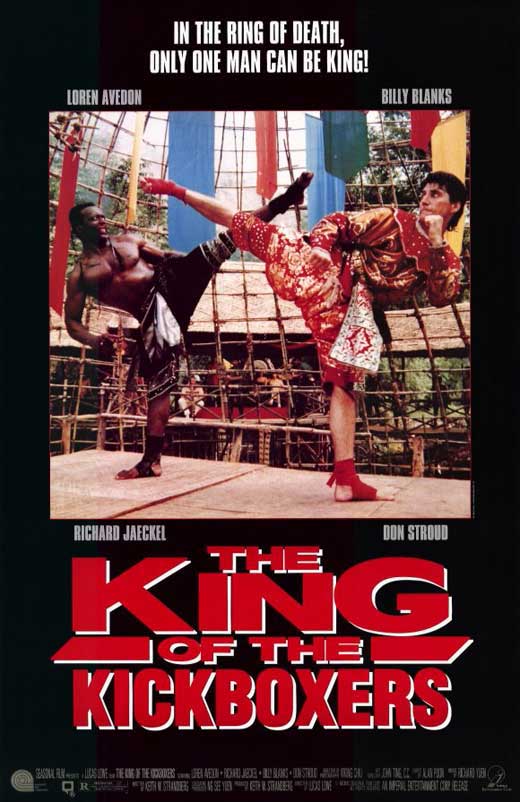
Episode #233: Loren Avedon The King of the Kickboxers

Welcome to a very, very special episode of our little podcast called the GGtMC!!!

This week, with the graceful presence and help of the great Karl Brezdin of Fist of B-List blog fame, we are honored to bring you a review of The King of the Kickboxers (1990) starring Loren Avedon and Billy Blanks. We are also blessed with the presence of Loren for a near 2 hour interview that was just amazing!!!

Check out Loren Avedon in other films as well...No Retreat, No Surrender 2 & 3, Manhattan Chase and Tiger Claws 3....just to name a few!!!

Direct download: ggtmc_233.mp3

 Emails to midnitecinema@gmail.com

Voicemails to 206-666-5207

Adios!!!


Wednesday, May 1, 2013

Zeta One (1969)


We have talked in the past about my dislike (okay, let’s call it “hatred”) of shaky cam filmmaking techniques.  Don’t worry; we’re not going to rehash that old saw today.  Today’s peccadillo is psychedelia in cinema.  In the 1960s, the youth culture was fed up with just about everything; war, consumerism, and all of the inequities of their parents’ society (real or perceived).  In the cause of opening up their minds, there was a growing trend in the use of psychedelic drugs.  These drugs can create a non sequiturial experience, and people felt that, via their various trips, they were being told the secrets to all of life and the universe (though I’m sure other people just relished the opportunity to escape from reality).  This experience, however, does not (in my opinion) usually make for good cinema.  The typical “trip” scene in a film from the late 60s on would consist of smash cuts to any variety of visual (the less coherent, the better), shots that look like the inside of a lava lamp, shots bled out with swirling colored lighting gels, shots of naked (they’re more likely than not covered in body paintings that make jailhouse tattoos look like the work of Goya but naked, nevertheless) hippies dancing and grooving out to the sitar-heavy score, and so on.  It all irritates the living hell out of me.  These scenes are ugly, vapid, and most ironic of all, clichéd (and I’m sure they have felt that way even from the very first).  I’m sure I’m being irrational about this to some extent, but it takes two to tango, as they say.  Some people get a headache from strobe lights.  I get a headache from head trip scenes.

Secret Agent James (Robin Hawdon) comes home to his hip, attic pad only to find sexy secretary Ann (Yutte Stensgaard) cooking up a little coq au vin.  After a bit of necking, Ann decides to grill Agent Word (as in “James’ Word is his Bond,” get it?) about his last mission in Scotland.  She decides to play strip poker for the information (yes, really), but eventually she winds up just banging him, after which James is more than happy to start giving up the goods (one wonders how he’d hold up under adverse conditions).  It seems Major Bourdon (James Robertson Justice) has been at war with the nation (Planet?  Island?  Dimension?) of Angvia for some time, and he wants to conquer the civilization, which is populated entirely by women and led by the titular Zeta (Dawn Addams).  ‘Nuff said. 

Michael Cort’s Zeta One (aka The Love Factor) was produced under the auspices of Tony Tenser’s Tigon British Film Productions banner.  Generally speaking (and I am no expert, though I know of at least one book in regards to the subject – Beasts In The Cellar by John Hamilton – though I can’t attest to its quality), the studio produced cheap Horror and Sexploitation films (though I believe there were one or two more serious films to come out of the company) to compete with the classier (and better-produced) output of Hammer Films.  Of Tigon’s total body of work, I would think that film fans are most familiar with Michael Reeves’ great Witchfinder General, and rightfully so.  Sexploitation Comedies like this one (Zeta One, not Witchfinder General) are the type of affairs which play it fast and loose with whatever trends are popular at the moment, and they are generally pretty sloppy in execution.  This movie is no exception.  The opening twenty-plus minutes of the film, which should either draw us into some type of story or, at the absolute minimum, do something to titillate the viewer (the old “Boobs Or Blood Every Ten Minutes” tenet) does neither.  Instead, we get a little bit of teasing and one of the longest card game scenes I’ve ever witnessed (minus the tension of, say, Martin Campbell’s Casino Royale).  Worse than that, once the strip poker game does start to actually get interesting, the editing suddenly switches to a lame montage style and drops the viewer back off at square one, exhausted and exasperated.  We have learned next to nothing, and it feels distinctly like our time has been wasted, despite what female flesh is on display.

The rest of the film plays out as a flashback, but even the framing device of the film is hamfisted and sloppy.  James and Ann spend minutes doling out exposition, rather than setting up the story quickly and allowing the rest of the film to play out of its own volition.  The editing of the remainder of Zeta One is just as horrid.  Outside of the basic concept, the scenes don’t connect together in any coherent way (and not that this endorses the psychedelic angle; it’s simply poor filmmaking and extremely irritating).  Scenes happen (a few are even sort of intriguing), but they don’t advance anything in the film.  They just take up time and move on (kind of like a feature length version of The Benny Hill Show, without the sophistication).  The key question that has to be asked then is, “does it matter in this context?”  Isn’t a film like this better off not making one whit of sense?  Wouldn’t having something like a plot just get in the way of checking out nekkid chicks?  Isn’t asking for more from a film like this just being a bit snobby?  Perhaps.  But I’ve seen hardcore porn that had more of a story than this movie, for good or ill, and better made porn, at that.  

The big draw to the film, of course, is the very concept of Angvia.  A place populated entirely by women is something straight out of the early pulps, and for us comic book fans, we’re familiar with it from Wonder Woman’s Themyscira/Paradise Island (Zeta even looks similar to that comics’ Hippolyta), and let’s not forget the fabled Amazonian culture of warrior women.  The Sapphic connotations are self-evident, and William Moulton Marston’s penchant for bondage in the early Wonder Woman books is hinted at in the Angvian warriors’ “uniforms,” which consist largely of purple lengths of rope and pasties.  Of course, on the opposite side are Bourdon and his male cronies (one of whom is named Swyne and played by skinny nebbish Charles Hawtrey).  The two factions are opposites in almost every way (aside from the obvious).  The men are crude and warlike (Bourdon even has an “interrogation room,” essentially a dungeon where women are tortured and, I assume, killed).  The women are peaceful and quasi-aristocratic but can still handle themselves in a fight.  The men rely on mechanical weapons.  The women can kill by channeling some inner power.  Of course, the one thing the women cannot do without men is get pregnant and perpetuate their race.  To be surrounded by beautiful women who just want to have sex is the big carnal fantasy of a good many men (or at least of a good many adolescent boys).  And even though some animal vestige hangs onto this fantasy beyond puberty, it doesn’t make the thought any less ridiculous when depicted onscreen.

MVT:  It’s crass and nigh-Neolithic and probably contradictory to almost everything I’ve just written here, but the best thing in Zeta One is the birds.  And I don’t mean the kind with feathers.

Make Or Break:  The opening of this film is a major Break.  It is dull and silly and overlong, and it sets the viewer up for tedium and tits (in equal measure, I grant you).  And if you haven’t a problem with putting up with the one just to get to the other, then good for you.  You’re a better man than I am (apologies to Kipling).   

Score:  4.5/10   

Saturday, April 27, 2013

Instant Action: Get the Gringo (2012)


I'm not sure if most people would use the word charming to describe Mel Gibson, but I will!

Written By: Mel Gibson, Adrian Grunberg, & Stacy Perskie
Directed By: Adrian Grunberg

I completely understand the amount of backlash directed towards Mel Gibson in recent years. As a human being he deserves all the derision he has received, and then some. Mr. Gibson is not a pleasant human being, or someone whom I would choose to associate with if he lived down the block from me. However, I always try to separate the person from their art. In the case of Mr. Gibson that means removing his woman hating and racism from the equation and focusing on him solely as an actor and director. I have no qualms proclaiming that I am a big fan of Mel Gibson, the artistic talent. I've enjoyed just about every performance of his that I've seen, and Mr. Gibson is one of the few big time Hollywood stars in recent times who I would say is just as much of an actor as he is a star. As a director Mr. Gibson is a formidable talent, with a a visual eye that has always impressed me. Taking all of that into account it shouldn't be surprising that Mel Gibson, the actor, straps Get the Gringo to his back and carries the film to all of its success.

As I said in the teaser, it's not easy to think of Mr. Gibson as charming. But, as an actor, that's exactly what Mr. Gibson is. He is gruffly charming in a way that gives his character in Get the Gringo a worn out feel. The cracks in his skin and the tired look in his eyes aren't just an act, they are a part of his being. The key to Mr. Gibson's performance in Get the Gringo is that he accomplishes said worn out feel effortlessly. I never got the sense that Mr. Gibson was trying to feel worn out, he just is and that suited his character of Driver just fine. The camera loves Mr. Gibson, and there's no reason that it shouldn't. His presence is magnetic and it is in Mr. Gibson's acting abilities that the film gains and loses all of its momentum.

Unfortunately all of the supporting characters in Get the Gringo are rather weak. The setting of the prison is a nice one, and it is populated with a number of colorful characters. The characterization of those colorful characters is paper thin, and that leads to problems whenever Mr. Gibson is not on screen. The relationship between Driver and the characters of Kid and Kid's mom are a prime example of the characterization problems in Get the Gringo. They have a solid base of a relationship, one that's interesting enough on its own. As the film moves forward the relationship stays at the same level because the supporting characters stay exactly the same. There's never enough emotional, or character, honesty given to the Kid or Kid's mom for me to care about them beyond being people associated with Driver. This is a problem throughout most of the film, and it does hurt the film a fair amount when the screenplay asks the shallow supporting characters to take over for Driver.

The action and violence in Get the Gringo is quite stylish and well done. I was especially fond of the way the film used blood, particularly the darkness of the blood on display. It's a small matter, but in a gritty film said grit is helped when a dark red glob of blood accompanies a guy getting shot in the eye. The opening chase scene was refreshing, and one of the few car chases in recent memory that is actually exciting. The penultimate showdown at the prison isn't so much an action set piece as it is a dramatic set piece for Driver with action moments inserted to mix things up. Still, the action in Get the Gringo was well done and captured my interest throughout. There's a grittiness to the violence and action in Get the Gringo that I appreciated, and I'm always down for some well done gritty blood and guts.

As a reclamation project I'm not sure that Get the Gringo succeeds. Mr. Gibson is great in his role of Driver, and the film on the whole is pretty darn good. But, as an actor Mr. Gibson never needed to undergo reclamation in the first place. He may be a scumbag of a person, but he's always been a great actor and Get the Gringo serves as further proof of that. In a day and age of codified and glossy action films, the grit and dirt of Get the Gringo is a welcome change of pace. Get the Gringo won't blow anyone away, but any fan of classic blood and guts action violence should come away from Get the Gringo with a smile on their face.

Rating:

7/10

Cheers,
Bill Thompson

Wednesday, April 24, 2013

The Spider Labyrinth (1988)

When I was young, I wanted to be a makeup effects artist.  The work of such artists as Jack Pierce, Dick Smith, Rick Baker, and Rob Bottin fired my imagination (names like Sergio Stivaletti and Gianetto De Rossi were still unknown to me, and where the hell’s the comprehensive book about the FX masters of Italy [he wondered as he jotted down a note to himself]?).  Rather ignorantly, I used to say that I wanted to be in special effects, not realizing that the two are not wholly the same thing.  But I wanted to create cool-looking characters like Rawhead Rex or the Mummy (in fact, I used to wrap myself in Ace bandages [or as much of myself as the couple we had in the house would allow, which wasn’t much on a portly kid]) not wire bullet squibs or build retractable blades.  Today, I’d probably kill for the opportunity to do any of it.  

Back to the point (which I so rarely have), one Halloween I got a werewolf makeup kit rather than one of those rigid masks and plastic non-costumes that were staples of the holiday for decades.  This makeup required the application of cotton to my face with a green (yes, green; I suppose the makers didn’t want kids being mistaken for rabid dogs and being shot in the streets, though I would suggest they had nothing of the sort to fear) liquid latex.  A set of vampire teeth to complete the illusion, and I found myself staring into the mirror at one of the worst monster makeups I had ever seen, even for one applied by a child.  The instructions said that if you removed the makeup gently, it would come off in one piece and could be used again (how droll).  Well, it didn’t come off in one piece, but I wasn’t terribly broken up about it.  My love of practical makeup effects continues to this day, and if this escapade taught me anything it is that even cruddy work can consume an inordinate amount of effort.  But there is still a difference between work that simply doesn’t succeed and work that doesn’t succeed because of laziness.

When Alan (Roland Wybenga) was a child he was traumatized by a giant (stop-motion) spider while hiding inside a wardrobe during a game of Hide & Seek.  As an adult, he is a professor of Oriental Languages and part of the Intextus project, whose committee calls Alan in to discover the whereabouts of one Professor Roth (László Sipos) who has gone incommunicado while working on the project in Budapest.  Alan meets Roth’s pretty assistant Genevieve (Paola Rinaldi) and even manages to meet with the Professor himself who warns Alan that he is being drawn into something from which he is not going to be able to extricate himself.  After a large black ball smashes through Roth’s window, and the older gentleman is subsequently found hanged and covered in webbing, things get really weird.

To say more about the plot of Gianfranco Giagni’s The Spider Labyrinth (aka Il Nido Del Ragno) would be unfair, since the whole thing hinges on mystery.  However, it is almost impossible to talk at any length about the film for the same reason, so there may be some spoilers ahead (I’ll try to avoid them, but I can promise nothing).  It has also come to my attention via IMDB that I watched what is probably the shortest version of the film available, so I can’t be certain that any of the film’s shortcomings are intrinsic to the film or its various forms.  I hate that.  Onward…

If you look anywhere that this film is written or talked about, the obvious references will be to the Giallo and Horror genres, and they are prevalent throughout, no argument (though I would suggest that this leans more toward the latter than the former).  However, I also noticed a heavy Noir aspect to the film, and I think it’s here that hairs can begin to be split.  Alan is a Man of Letters but he has a past which haunts him into the present.  In fact, the film is obsessed with motifs of the past.  As the film opens, Alan drives in an old car listening to Oldies music.  He sees a young boy decked out like one of the “Dead End Kids” at multiple points in the film.  Roth lives in an old, decaying apartment building.  The Intextus project is interested in old religions and (probably) older gods.  

Further, Alan is a man who is held prisoner by a fate he cannot escape, and this accounts for the arachnid and maze themes.  Consequently, there are spider webs galore as well as piles of wood and barbed wire which block roads, a labyrinth made up of windblown sheets, and long stretches of road which reveal nothing of a way out, just more confusion.  The filmmakers string the plot along like a gumshoe flick from the Forties, with questions leading to answers leading to more questions.  There are heavy shadows and low angle lighting in almost every interior shot of the film, as well as the use of poor weather as a portent of doom and thick fog which obscures the truth and in which danger lurks (as well as a little illumination).

The Spider’s Labyrinth also deals at length with concepts of conspiracy, paranoia, cultism, and institutions versus individuals.  When Alan is called before the Intextus committee, he is essentially cajoled by a priest (Bob Holton) and coerced by the tacit implications in the presence of a pair of corporate executives (John Morrison and Bill Bollender), that being the threat of losing his livelihood.  Of course, the Intextus committee is fully aware that they are sending Alan into a perilous environment, but they mention nothing of this to the man.  Nearly everyone in Budapest gives Alan sideways glances, and there are a great many shots of people around our main character trading knowing looks with each other.  Add to that, everyone who discovers anything about the Weavers tends to become overly suspicious of everything, and their dialogue tends to lean toward the realm of street corner preachers.  The members of the Weavers are all characterized as classic cult members; hive-minded, zombie-esque, untrusting, and untrustworthy.  Of course, the inferences of trust can also be applied to the Christian representatives in the film.  Thus, Alan is alone in a hostile world, torn between two deities, and losing his sense of self in the strands of some very metaphorical webs.

And so we come to my grievance with the film.  Without getting too far into details, Giagni and company drop a huge reveal fairly early in the going (in the scene with Maria the hotel worker, played by Claudia Muzi).  Afterward, the film seems to want to keep up the pretense that what we have seen may not have been entirely real, despite certain aspects of the event being true in the cinematic world based on how they are depicted in the film and (far more significantly) who witnesses them.  That the film maintains this façade for as long as it does is frustrating, since the movie could just as easily have moved into this strange, new territory and continued developing itself in that direction.  But since the film wants to be Giallo, Mystery, Horror, Noir, and Psychodrama for as long as it can perpetuate any one of them, it eventually crumbles in the end, falls back on the easiest of these to pull off (or the easiest in terms of wrapping up a film and giving the audience a cheap thrill), and leaving the audience stuck between bemused and befuddled.  Despite this, it is an intriguing and entertaining film, and I’d like to think that an inspection of its extended cut would provide a smoother transition between its disparate flavors.

MVT:  The general atmosphere surrounding the film is moody and effective.  The film also looks great thanks to some fantastic scenery and the cinematographic eye of Sebastiano Celeste (credited as Nino Celeste).  So, even if you’re let down by the way this film was written, you certainly cannot say the same thing about the way it was photographed.

Make Or Break:  The Make is the scene of Alan’s first night at the hotel.  As he is getting settled, he spies Genevieve (at least I think it is she) across the way undressing and cavorting around her place.  It brings to mind Hitchcock’s Rear Window, DePalma’s Body Double, and other films while being alluring and runic all on its own.

Score:  6.75/10  

Monday, April 22, 2013

Episode #232: Last Night & Feedback

Welcome to another episode of the GGtMC!!!

This week Sammy returns from his time away from the show and we cover Last Night (1998) directed by Don McKeller. This film was selected by Deadly Dolls Emily for our Kickstarter campaign and we thank her for the support. We also cover some listener feedback and give you a sneak peak into next week's show we are chomping at the bit to do!!!

Direct download: ggtmc_232.mp3

Emails to midnitecinema@gmail.com

Voicemails to 206-666-5207

Adios!!!


Friday, April 19, 2013

Episode #231: Crazy Thunder Rush

Welcome back to another episode of the GGtMC!!!

This week Large William is joined by PickleLoaf from the Silva and Gold podcast for coverage of Crazy Thunder Road (1980) directed by Gakuryu Ishii and Terminal Rush (1996) directed by Damian Lee. We want to thank Loaf for stepping in during Sammy's absence and check out the Silva and Gold podcast if you havent already!!!

Direct download: GGtMC_231.mp3

Emails to midnitecinema@gmail.com

Voicemails to 206-666-5207

Adios!!!