Wednesday, April 4, 2012

Flesh Gordon (1974)


Strange sex rays have been bombarding the Earth, causing groups of people to erupt in spontaneous orgies. The leaders and scientists of the world, including Professor Gordon (John Hoyt), are baffled. Meanwhile, the professor's son and all-around great hockey player, Flesh (Jason Williams), is flying back home (on the only airplane I've ever seen with rattan chairs for seats). In flight, Flesh meets cute with Dale Ardor (Suzanne Fields), but before the two can get to know each other, another sex ray hits the plane. Flesh and Dale barely escape with their lives, but they meet up with famous (or infamous) paranoid scientist, Dr. Flexi Jerkoff (Joseph Hudgins), who has discovered where the rays are coming from (the planet Porno). The trio makes off (or out) for the planet in Jerkoff's penis-shaped spaceship. After being forced to crash land on Porno, Flesh, Dale, and Jerkoff partake in a series of adventures in their quest to defeat the evil Wang the Perverted (William Hunt).

Pornography carries different connotations in different contexts. To some, it's something as simple as the baring of the human body in all its glory. To others, it's the graphic depiction of sexual intercourse. To still others, explicit violence and gore is considered pornographic. There are even those who find pornography in the use of words alone (just ask Lenny Bruce or "Penthouse Forums"). In the obscenity case surrounding the film, The Lovers, Supreme Court Justice Potter Stewart famously stated, "I shall not today attempt further to define the kinds of material I understand to be embraced within that shorthand description ["hardcore pornography"], and perhaps I could never succeed in intelligibly doing so. But I know it when I see it, and the motion picture involved in this case is not that." Slightly less famously, Jello Biafra, when detailing his obscenity trial for including H.R. Giger's Work 219: Landscape XX (aka Penis Landscape) with his band Dead Kennedys' album "Frankenchrist," described the "prurient interest" (the crux of the case against him) as (and I'm paraphrasing here), "if you look at it, and it makes you wanna whack off." Much less famously (unless you're a dork like me) but more amusingly, the cover of issue sixteen of Betty And Me shows Archie Andrews carting off casual sweetheart, Betty at the local water hole. In response to her question, "Archie, did you have any trouble rescuing me?" his reply is, "I sure did, Betty! I had to beat off three other guys!"  Naturally, there are three bruised up rivals in the water behind him, but if all you did was hear that line, would you consider that pornographic? Maybe. Maybe not. 

Taking a cue from Mr. Biafra, then, should porn appeal to more than the prurient interest? I'm sure pornography has been with us in some form or another going all the way back to the time of cave paintings. By that same token, the genre has straddled (wow, the double entendres on this are unavoidable) both sides of this query. Like cinema's beginning, when Eadweard Muybridge discovered flicker fusion while trying to answer the question of whether or not all four of a horse's hooves leave the ground while galloping (incidentally, they do), porn has been both plotless and plot-centric. 

Short loops simply depicting folks doing "the nasty" have existed alongside more involved productions (along the lines of "what the butler saw" style narratives) for years before graduating into full-blown features. And yet, even a porno with the most well-developed and verisimilitudinous of plots and three-dimensional characters is still a porno. The sex scenes are integral to their existence (and for the sake of our discussion here, we'll only consider the "sexual congress" angle of pornography), and while they can be enjoyed by themselves (appealing to the most base of desires as they do), having a contextual framework around these scenes can provide not only an additional level of enjoyment but also partially legitimates their production in the eyes of filmmakers and viewers alike (though not necessarily in the eyes of those predisposed to disliking them in the first place). The above question regarding appeal, then, becomes answerable only when framed by the individual viewer's perspective. But that doesn't mean that you can't like it both ways.

As a production, Flesh Gordon is not much to write home about. The 16mm cinematography is alternately blurry or just plain ugly. The compositions consist of establishing shots and medium to medium close-up shots. The camera is primarily static. That said, the visual and special effects (most notably some nice, low budget stop motion work by David Allen and Jim Danforth, here pseudonymously credited as Mij Htrofnad, as well as some early-ish work by Rick Baker) are, for the most part, thoughtful and effective. The shots involving effects all seem (at least to my jaundiced eye) to have not only a stronger sense of composition but also a predilection to actually move the camera. Really, they are one of the film's strongest assets, and they deliver.

Inevitably, then, how does this little opus stack up on a pornographic level? Can it even be called pornography? Yes, I think it can. It goes further in terms of not only amounts of skin shown but how they're shown than other sex comedies. Is there penetration? None is graphically on display, though if you look carefully at the extras in the background of Wang's throne room, there's some genuine nookie going on, as well as some definite handies being applied to definitely turgid members. In fact, the only scene that is treated stylistically like hardcore porn is the love scene between Flesh and Amora (Mycle Brandy) (complete with funky, wahwah pedal guitar licks but without onscreen intromission). My understanding (and I find this very easy to believe) is that live-action co-directors, Howard Ziehm and Michael Benveniste, did film hardcore sex scenes, but they were edited out of the film. My guess would be because porn was considered in many areas to be a criminal enterprise for the majority of the Seventies, and the filmmakers wanted to (understandably) avoid prosecution. It would be interesting to re-look at the film if this material ever resurfaced. Further, the actors are not particularly attractive (as was the norm for the time in this type of affair), but everyone seems to be having a real ball (ahem). 

And this is the film's other saving grace. The film and filmmaker's attitude is one of reverence and playful satire for the works that inspired it. This is stated outright in an opening text scroll extolling the pulp serials of the Thirties and Forties, from Captain Marvel to (the original) Flash Gordon. The film is a romp, "in the spirit of burlesque." Throw in some broad (and some subtle), bawdy humor, some death traps that you have no idea how our heroes will get out of but still know to a certainty they will (just like in the infamous cliffhangers of yore which invariably resulted in a cheat of some form or another), some naked people rolling around and groping each other, and you get a film that, technically, is only worthwhile on an effects lover's level, yet still exudes a mischievous sense of adventure that makes the whole thing go down (ahem, again) a pleasant enough treat.

MVT: The overall sense of delight makes up for the majority of the film's deficiencies. If it wasn't for this mien, the film wouldn't be overly appealing to anyone other than special effects devotees, I think. Still, this would make a hell of a party movie.

Make Or Break: The Make is the airplane scene. Everything to enjoy about the film is contained herein. You have some okay effects, some action and adventure, a mildly fun-looking orgy, and that pervasive sense of amusement that holds the whole affair together.

Score: 6.75/10


**Like this review?  Share it with a friend.  Hate it?  Share it with an enemy.**

Tuesday, April 3, 2012

Episode #178: Blindman Straits

Welcome to a hot and heavy and fast recording of the GGtMC!!!

Sammy and Will were under the crunch this week due to scheduling issues but somehow (even to our own amazement) able to crank out an episode of the show....I am still short of breath. You get all the goodness in a GGtMC packed hour, don't worry gang this show will not become our standard we just had to haul ass for this one.

The Gents cover Blindman (1971) directed by Ferdinando Baldi and Florida Straits (1987) directed by Mike Hodges...we had much to say about one and not much to say about another...can you guess which one?

Direct download: Blindman_Straits.mp3

Emails to midnitecinema@gmail.com

Voicemails to 206-666-5207

Adios!!!


DVD/Blu-Ray Picks Of The Week - 4/3/12

Chad's pick: TODD AND THE BOOK OF PURE EVIL (Region 1, DVD; Paradox)
One of my favorite recent discoveries was stumbling upon Todd and The Book of Pure Evil. Simply put, this TV series is a blast. Imagine Evil Dead meets Shaun of Dead set in high school, and there you go. Constantly hilarious, and featuring practical F/X work (Man in Rubber Suit galore!!!). The show is criminally underseen, at least here in the States, since it airs on a channel (FearNet) that few cable providers offer. You can pick up Season 1 in the U.S. now, and if like me you can't wait months on end for the Season 2 release then cherry pick across the border!

Links:
Amazon US (Instant Video)
Amazon Canada (DVD)

Monday, April 2, 2012

[REC3]: Genesis (SXSW 2012)


Directed by: Paco Plaza

It might very well improve your viewing experience to pretend that this film is not entitled [REC3].


As it is, [REC3]: Genesis follows the zombie outbreak to a wedding reception as partygoers-turned-flesh eaters rapidly turn the proceedings into a bloodbath. Amidst the carnage, newlyweds Clara (Leticia Dolera) and Koldo (Diego Martin) are separated and must hack their way through undead friends and loved ones to reunite.

Yeah, not exactly what one expects as a description for the third installment in the [REC] series (and that's without mentioning the format switch). A little underwhelming, perhaps? Not very rousing, I agree. So, let's try redacting the title and running the description back one time.

[REC3]: Genesis follows the zombie outbreak to a wedding reception as partygoers-turned-flesh eaters rapidly turn the proceedings into a bloodbath. Amidst the carnage, newlyweds Clara (Leticia Dolera) and Koldo (Diego Martin) are separated and must hack their way through undead friends and loved ones to reunite.


Sounds better, doesn't it? At least, a little bit? Point is, redact the title, ignore it, maybe swap it for something else -- Dead Wedding, Till Undeath Do Us Part, Zombie Honeymoon (oh, wait...) whatever -- it just plays better casting that title aside. For better or worse, [REC3] is brand identification, and this film is not indicative of that established label. That said, I'm unsure if it's fair of me to hold it against the finished product for not delivering on what I think the film should be. Perhaps, I've saddled the picture with unfair expectations. Although, I doubt I'll be alone in that department.


While I'm staunchly not in favor of the found footage genre, I greatly appreciated and enjoyed the first two [REC] movies. In fact, I prefer [REC2] despite the re-treading nature as the film offered a fresh perspective and a killer conclusion that promised something grander ahead for the next film. Unfortunately, [REC3] fails to live up to that promise. It does not go bigger. It does not expand on the mythology. It doesn't really answer some of the more pertinent questions. And what's most frustrating, based on the production value displayed, it certainly appears that the filmmakers had the budget to do all those things with this feature.

Now, if you can sever ties to the [REC] franchise, there's ample to enjoy. The director, Paco Plaza, severs those ties early on and aggressively by visual means. The film's first stanza is presented as a found footage wedding video, setting up the characters and dropping the cues of the forthcoming infection. Frankly, it's the least interesting section of the film, and I welcomed the abrupt shift to a standardly shot film as the handheld shaky cam disappeared. The switch happens suddenly as Koldo rips the camera away from the videographer, smashes it against the floor and toebashes the lens until we cut to the red recording dot on a black screen. This red dot slowly fades then dies, and the found footage look dies along with it. When the film fades back in, we pickup right after the camera-bashing except now all is lensed in a cinematic scope. This rough transition symbolizes the change in direction, signifying that this will be a very different [REC] movie visually, narratively and tonally.

One of those stark differences is the tone. Gone is the straight-ahead bleak scarefest typical of the previous installments. In it's place is more of a horror-comedy hybrid that emphasizes sensationalized gore. Before you'd see a character yanked off screen screaming in agony only to return as a blood-drenched deadhead whereas now you'll see that character mobbed and bloodily chewed asunder. Or previously you'd see someone cower, hide and scramble for cover as opposed to the latest approach that sees our groom goofily dawn knightly armor to protect himself as he searches the reception hall. Putting expectations to the side, it all works quite well and makes for a lot of fun.


Technically speaking, Plaza deserves credit for excelling at making a traditional horror film. Whether it was his intention or not, Plaza certainly proves that his talent isn't relegated to the found footage stylings. [REC3] is beautifully shot, rich and vibrant. After the format switch, I anticipated that Plaza might struggle blocking action scenes, reflexively falling back to a handheld camera operator documenting the events with way better image quality. Fortunately, Plaza's action direction is strong in places, if not spectacular, and always solid. If anything the direction lingers a bit long, at times, on the attacks and gore in sort of the opposite end of the spectrum from the "peek-a-boo" found footage approach. In regard to the horror effects, Plaza doesn't shy from putting the gore on display, and does so with largely practical applications rather than CGI over-reliance. And while I've been critical in the way expectations were defied, I still must credit Plaza for attempting to divert the [REC] formula in so many phases and bravely jettisoning the safety of found footage.

If you're familiar with this franchise, you know that Plaza co-directed the prior films with James Balaguero yet helmed this one alone. Apparently, the pair opted to split up in order to finish off the franchise so each could craft their own final entry to complete the trilogy. Thus, it seems as though we'll have the unique situation where we have four films comprising a single trilogy by swapping out one or the other on the backend. Even with this line of thinking, Balaguero's film will carry sequential numbering, tentatively titled [REC4]: Apocalypse.


Make or Break scene - The high point of [REC3] occurs in a tunnel/corridor where Clara has the opportunity to escape clear and free, but instead she makes a stand; she opts to turn around and fight through a zombie horde, vowing not to leave without her husband. This scene succeeds on multiple levels. For one, you believe Leticia Dolera's conviction and unrelenting love, never doubting for a second that she would march through infected monsters. And second, she doesn't march through them empty-handed, but rather with chainsaw-in-hand and sexily tearing her gown to skirt length for better zombie-killing technique. Also, as corny as it may sound, Clara bellows that this is her day -- the bride's day -- and no one's going to ruin it as she cuts her undead assailants to bits, working to wonderful comedic effect. And if anyone tries to steal her special day, as the cool action unfolds, she'll feed them a roaring chainsaw blade. Literally.

MVT - For many of the reasons listed above, Leticia Dolera as Clara is the most valuable thing about the film. I love the ferocity with which she conveys her determination in finding Koldo. At the same time, she's able to portray a very heartfelt emotional performance, especially in creating that necessary chemistry with Koldo. Her performance is so well developed that it enhances Diego Martin's work as Koldo, making you understand why he, likewise, refuses to vacate the premises without his wife.

Score - 7/10

Saturday, March 31, 2012

Society (1989)


I wanted to like “Society” more than I did. I enjoy Brian Yuzna’s style of filmmaking and feel his strange and outlandish imagery can be grotesquely beautiful. I’d even go on record to say that the outrageous imagery on display here is done fantastically. My problem is, for once, I felt it wasn’t necessary in one of his films.

With the way the story had been built, there were two ways to go. Bill Whitney (Billy Warlock, who is the lovechild of John Stamos and Emilio Estevez) feels like an outcast in his family. Despite his many successes (such as in basketball and being the next class President), he’s always felt his parents gave more attention to his sister, Jenny (Patrice Jennings). He’s of the belief that he’s adopted. His school psychiatrist believes he’s becoming slightly paranoid. I began to think the same thing in the first twenty minutes. The way Yuzna was handling the character and his peculiar visions pointed towards Bill descending into madness.


When I felt the film was going this route, I was find with the abnormal imagery that has become Yuzna’s staple. It added to the film and played off of the story well. It’s not a spoiler to reveal that Bill’s delusions are real, as it’s not only revealed within the first twenty minutes, but all of the promotion for this film announces it.

That’s not to say the film is predictable. Yuzna keeps you guessing, occasionally teasing the paranoia, but mostly just screwing with the audience. Any time Bill gets a lead or evidence in his favor, it all disappears out of the blue. This ties in briefly with the paranoia, though it’s pretty easy to tell it’s all a cover up. It’s also pretty easy to tell what is being covered up, though Brian still finds a way to surprise you.

Once the final act kicks in and we find out all of the answers, I was disheartened. I liked the message Yuzna was conveying. I just didn’t like the way he was going about it. The crazy and freakish approach undermined the message for me. That message being that the upper class feel they’re superior and in a society of their own. That they have good breeding. Yuzna didn’t need to incorporate outrageous effects to prove this point, even if it’s his trademark.

“Society” is best described for me as a rusty rollercoaster. It still operates and delivers a few thrills. However, it’s too bumpy and can cause fits of discomfort. Discomfort may be a positive for most Yuzna films, but it’s not here. As great and disgusting as the effects were, they didn’t captivate me like they did in some of his other work. Here, they just didn’t seem to serve the right purpose.


MVT: As great as the effects are, I didn’t feel they quite fit in with the outcome. Therefore, my MVT is Billy Warlock. He may have been a bit uneven in spots, but he played a likable lead who I could get behind. With a bit more seasoning, he could have been a bigger star. Too bad that never panned out.

Make or Break: The final act broke the film for me. Broke is a bit too harsh of a word, but it’s what I have to use. It certainly didn’t make the film for me.

Final Score: 5/10

Thursday, March 29, 2012

The Cabin in the Woods (SXSW 2012)


Directed by: Drew Goddard

The Cabin in the Woods
is like every other horror you've seen. It could, in fact, be every horror movie you've seen.

If that sentiment doesn't make sense to those who have yet to see the film, I advise not trying to make much sense of it until after a viewing (and stay away from the new spoilery trailers while you're at it). Admittedly, it's hard to write anything of substance without spoiling a few items. The surface plot description sounds like a million horror movies. A group of reckless, fun-loving college kids go on a little cabin getaway deep in the woods. You know these kids, there's the hot party girl, Jules (Anna Hutchinson), her muscled beau, Curt (Chris Hemsworth), their good-girl best friend, Dana (Kristen Connolly) and the good guy, Holden (Jesse Williams), they set her up with for a weekend tryst. Oh, and certainly, there's a stoner tagalong, Marty (Fran Kranz), who wields one of the greatest bongs in cinema history. Of course, cue the scary trailer voice over guy to inform us that this is no ordinary cabin in the woods. A night of drinking, drugs, sex and hijinx leads to the dark and haunted truths about their kickback spot. It seems like so many other horror films, both in description and title, I know. The cabin these kids stay in is even identical to the one from The Evil Dead movies. And yes, that's all by design. And while it's easy to succumb to the familiarity, what unfurls is something much different from standard horror fare.

Without giving away too much, let's say that The Cabin in the Woods has much bigger things in store, both narratively and entertainingly, than the shallow high concept indicates. The big twist is overly apparent from the opening, if not outright then with enough heavy leanings that you'll put the pieces together rather quickly. Even if the biggest twist is blown for you, I still highly recommend checking this out in a theater with a live crowd because it's an immensely good time. For those horror fans who prefer their terror pics straight-laced, fair warning, a large part of the entertainment value derives from the comedy. I wouldn't say The Cabin in the Woods is trying be a comedy foremost. The humor predominantly stems from the lovingly satirical elbowing of this genre, which plays with conventions and sensationalizes established beats to fine comedic effect.

To some degree, the sense of humor is akin to Scream (and I realize that's something of a dirty word, though I've professed my love of the film on this very blog before) without the albatross of the main characters omnipotent horror movie knowledge, and thereby preserving the perilousness of their circumstances. There are two halves to the film, and in this other half, those characters are assuredly aware of the "horror movie" unfolding. However, where this approach differs, and thus maximizes the entertainment factor, is that we as viewers are right alongside these characters, both laughing at the obviousness of what's to transpire and enjoying all the supernatural and survivalist elements that comprise the best parts of the genre.

And while this angle is played for laughs, director/writer Drew Goddard and producer/co-writer Joss Whedon bring the carnage and some genuine scares. In the early-going, the terror comes by way of the undead redneck zombie family that our party kids unknowingly summon from the grave. Initially, these slashers seem a bit generic, but they're utilized quite well to a jarring effect through various stalk scenes and chain-wiedling action, especially when they first strike. As the film unfolds, these killers are honestly just the tip of the iceberg as we're introduced to a cadre of villains, slashers, monsters and madmen that widens the scope of the picture. Whedon described The Cabin in the Woods as one of his first film projects where he just completely threw himself into the story without any concerns toward budget, salability or studio backing, and it honestly shows. This really is an unbridled horror fanatic throwing everything up there including the kitchen sink.


The real highlight of the cast is easily the pairing of Richard Jenkins and Bradley Whitford as Sitterson and Hadley respectively. Playing something of an irreverent office cubicle duo, they throw themselves headlong into their roles, charisma set on overload and pushing the hilarity throughout. Like us, they seem a bit weary of their job (and doing the same old thing, or watching the same old horror movie things) and strive to find ways to entertain themselves whether that's through orchestrating office pools, pulling workroom pranks, injecting some levity into unfunny predicaments or overacting to blow off a little steam. Personally, I love watching Richard Jenkins contract a serious case of red ass. It's a great time whenever Sitterson blows his stack over something not going his way with a surly attitude and salty language; there's a machine gun barrage of F-bombs fired off that especially had me cracking up. It's not a shocker that an esteemed actor like Jenkins would steal the show, but it is a little more of a surprise to see Bradley Whitford shine this brightly. Obviously, Whitford is known for his television resume, of which I've seen little, but I've never seen him in this type of role or in this style of film -- and he excels at it, exuding plenty of charm and comedic chops. Whitford instills Hadley with more of a sardonic "who cares" humor that strongly compliments Jenkins' firecracker performance. As for others in the cast, it may interest you to check out the Son of Asgard himself pre-Thor Chris Hemsworth playing brawny jock-type, Curt.


Make or Break - You might want to skip this paragraph as I'll need to reference a pivotal scene. The make scene of the film occurs when Marty and Dana stumble upon the massive holding cell of creatures far beneath the campsite. The whirling prison cell and monsters contained within them is a great surprise, and this scene ratchets up the anticipation to see more of this subterranean facility. It's the type of scene the demands repeat viewings to catch everything, and one that will most likely reward you upon revisitation.

MVT - Drew Goddard and Joss Whedon, the screenwriters. Not that Goddard's direction isn't integral, but the story and concept star here. There's a lot packed into the narrative in terms of story design, genres and characters, and they all congeal so admirably that the writing needs acknowledgement.

Score - 8.5/10

And after you've seen this, it occurred to me that the short film Cost of Living would make a fine little double feature as the first salvo of a one-two late night punch.

Wednesday, March 28, 2012

Nemesis (1992)


I started wearing prescription eyeglasses in fourth grade (I know, boo hoo). I have not stopped wearing glasses since then. I have never tried (nor wished to try) contacts. I have debated getting Lasik surgery done, but let's face it, it costs a decent amount of money, and the people I know who have had the surgery done still require glasses to read. I spend an inordinate amount of time reading. What good is the surgery, then? The way I figure it, I'm wearing glasses anyway, and it's the devil you know versus the one you don't. Consequently, I have never owned a "cool" pair of sunglasses. I have bought prescription sunglasses in the past, but changing glasses everytime you enter or leave a building is a bigger pain than you would think. So now I have a pair of slip-on shades for my glasses. They may not be as cool as Dwayne Wayne's, but they suit me just fine. What's the point of this little discourse, you may ask? I don't think I could hack it in the world of Albert Pyun's Nemesis. Everybody in this movie wears sunglasses at all times (okay, most times). How do they not run into the furniture?

In the future...Alex (Olivier Gruner) is a cyborg working for "the Man" to bring down bio-engineered and synthetically-enhanced gangsters, hookers, terrorists, and so on. After getting blown up real good during a mission to grab a microchip, he winds up convalescing in a border town in Baja, New America. There he is contacted by fully-synthetic ex-girlfriend, Jared (Marjorie Monaghan, who I would have sworn was actually Linda Fiorentino), to come back into the fold. Instead, Alex becomes a smuggler of something or other on the black market. After myriad machinations too complicated to actually delineate here, Alex is tasked with getting a microchip containing VERY IMPORTANT INFORMATION to the revolutionary gang, the Red Army Hammerheads, and stopping the robots (cyborgs, synthetics, androids, whatever the hell) from taking over the world. 

This future vision of the world (along with ninety-nine-point-nine percent of the ones depicted in every form of media) is, of course, a dystopian one. Almost every set and town in the film is crumbling away and usually industrial in nature. Filters are used to give us the notion that our atmosphere has been permanently changed by some cataclysm. You've seen this effect before, especially if you've seen many movies from the Eighties and Nineties. I like to call it the "Los Angeles Filter," since you'll see it frequently used on establishing shots of Los Angeles, even if a nuclear holocaust hasn't occur (shorthand for smog, perhaps?). There's lots of rain (we can assume it's acid rain), and everything is just ugly. Interestingly, the robots say that they want to create a utopia by eliminating humans and replacing them with cyborgs. In other words, it's humans creating the problems faced by the world. And yet, if people didn't exist, the question must be asked, what would the robots do with themselves all day?

Let's just lay it on the line, shall we? There isn't an original bone in this film's body. Everything from the Hong Kong action movie scene of the Eighties and Nineties to Blade Runner to The Six Million Dollar Man to the work of William Gibson and the entire cyberpunk movement and more are referenced, either directly or indirectly. The writer, Rebecca Charles (whose only listed film credits on IMDB are for the Nemesis trilogy, yes, trilogy), loaded the movie up with film noir and tough guy touches. Jared narrates the film like Sam Spade or any other of a thousand private dicks, regardless of the fact that she's only in a few scenes and isn't the main character. This is not to say that a supporting character can't be the narrator, but it's not the norm (hell, Joe Gillis was dead, and he still narrated Sunset Boulevard). Speaking of the dialogue, it's meant to be hard-bitten and pithy, but instead it is glaringly self-conscious and clunky.

One refreshing aspect of the film is the amount of badass women it. Right from the first scene, we are given women unafraid to get their hands dirty and who know how to handle firearms. In a genre dominated by men and the male gaze, I love it when the other fifty percent of the world can stake out some terrain. And the irony that they look very good doing it is not lost upon me. Still, the women in this film are strong and, more often than not, shown as being superior to men both physically as well as in rank and mental acumen. Julian (a very muscular Deborah Shelton) has Billy (a very young Thomas Jane) killed, performs surgery on Alex, and sets him on the right path. All before putting on her sunglasses (see?) and shooting up a good portion of the hotel in which they meet. Jared is the sage whose data can save the entire planet. Max Impact (Merle Kennedy) has the Lori Petty/trickster role as the young cynic who wants revenge against Alex but will later become a strong ally. They all add something, and the film wouldn't be what it is without them, I think. Or at least, not as distinctive.

But let's call this what it is. Nemesis is a mess of a film. The plot is convoluted to the point of incoherence. The viewer is never absolutely sure whose side who's on, or which side we (as an audience) are supposed to root for. The character development is so thin, it only has one side (thank you and apologies to Red Skelton). The dialogue can actually induce wincing in those watching. The acting (with the exceptions of Tim Thomerson, the late Brion James, and Monaghan) is so wooden, one could easily come away with splinters. The film has nothing new to say about any of its themes (what it means to be human and so forth). And while the special and visual effects (including some decent stop motion) and stuntwork are solid for a low budgeter like this, the movie on the whole is nothing more than an excuse to cram ninety-six minutes with action and a little skin. 

Why, then, do I take such delight in something as meaningless and bewildering as Mr. Pyun's little opus? I think it's because this is one of those rare instances where style actually does triumph over substance. Whether it's caused by the overload of the puzzling goings-on or the barrage of action, I found myself just giving in to the spirit of the whole affair. Maybe I was just beaten into submission by it. 

MVT: The persistence of style and the pure abandon of any semblance of coherency make this film more fun than it really has any right to be. In other words, it just feels good.

Make Or Break: The Make is the scene where Alex is being chased by the bad cyborgs (I know, which time, right?). A cyborg (played by an uncredited Sven-Ole Thorsen) harasses a little old lady on the street. Having taken enough guff from this whippersnapper, the biddy (Mabel Falls) pulls out a rather large gun and blows Thorsen away. It's one of the more overtly humorous scenes in the film, and even though it's predictable (just like the rest of the movie), you can't help but love it.

Score: 7.25/10


**Like this review?  Share it with a friend?  Hate it?  Share it with an enemy.**

Tuesday, March 27, 2012

DVD/Blu-Ray Picks Of The Week - 3/27/11

Sammy's Pick: A NIGHT TO REMEMBER (Region 1 Blu-Ray; Criterion)
The best film about the tragedy of the Titanic....it lacks Winslet's breasts and the ego of James Cameron's version...but it makes up for that by being a better film.

Links:
Amazon
BoulevardMovies.com
Blu-Ray.com Review

Episode #177: What Have I Done to Deserve This?

Welcome to another in our long line of special episodes at the GGtMC!!!

Sammy was out of town attending HorrorHound Weekend 2012 Columbus, so William grabbed some friends and decided to talk shop about Pedro Almodovar's What Have I Done to Deserve This? (1984).

Large William is joined by James McCormick from the Criterion Cast, Cristina from Girls on Film Radio and Death Rattle Aaron who is editor-in-chief of the GBtMC and author of the blog The Death Rattle. Star studded folks!!

Direct download: DeservingRM.mp3

Emails to midnitecinema@gmail.com

Voicemails to 206-666-5207

Adios!!!

Oh yeah BTW.....Sammy met Pam Fucking Grier!!!!


Saturday, March 24, 2012

Grim Prairie Tales (1990)


I was suffering from a bad case of insomnia. I had a few hours left until my shift began, yet I couldn’t fall asleep. I was tossing and turning and counting sheep to no avail. As each minute passed, I kept thinking of how much time I’m wasting. If I’m not sleeping, I might as well be doing something. Therefore, I decided to pop in “Grim Prairie Tales”, which I had settled on being my next review.

If there’s one good thing to be said about “Grim Prairie Tales”, it’s that it cured my insomnia. After approximately forty-five minutes, I was out like a light. It didn’t give me a lot of sleep for work, but I at least got some. I can thank Wayne Coe’s anthology thriller for that. Which is about the only thing I’m thankful for about this movie.

The only reason it took me forty-five minutes to finally doze off was because of Brad Dourif and James Earl Jones. Both are clearly picking up paychecks, but are playfully chewing up the scenery. Their sets together are laughably overacted, though I’m pretty certain that was their intention. Both are fantastic actors who have churned out good performances in terrible movies. Them not putting forth a satisfactory performance in the traditional sense makes me believe they were rightfully phoning it in. If not, they’re gifted enough that they can badly chew up scenery, yet make it work.


They play Morrison (Jones) and Farley (Dourif), two travelers who happen upon one another at a campfire. Not being able to sleep, they tell one another scary stories. In between the tales, they bicker back and forth. Jones frightens the shit out of Dourif, while Brad comes back with weasely insults. These scenes are worthy of a Youtube collection, which is the only way I’d recommend watching them.

As for the stories themselves, they’re as frightening as an episode of “Sesame Street”. All of them revolve around the prairie lifestyle and they all suck. The first centers around a man who messes with an Indian burial ground and has a curse put upon him. The second is of a man’s newfound friendship with a pregnant woman who harnesses a deadly secret. The third is of a daughter who discovers her loving father is actually a cold-blooded murderer. The fourth and final one revolves around a gunslinger haunted by dreams of being killed by his sworn enemy.


Not a single one is built up well. Each drag by slowly, which would be fine if tension were built. The only thing built is boredom. Each has a twist ending, which most likely gave M. Night Shyamalan an erection. All of them seem to have been built around their endings, as if Coe thought of them first, then poorly built a story around it. The only tale closely resembling quality is the final installment. By then, I could barely bring myself to care to pay attention.

If I should give any pointers, it’s that I thought I had the ending figured out earlier on. I’m referring to the closing of the film that inevitably features Dourif and Jones. Coe caught me by surprise with a rather calm ending. Once the credits rolled, I began to wonder if the “predictable” ending would have been better. I didn’t think for too long. I wanted to get this film out of my memory fast.


MVT: Both Brad Dourif and James Earl Jones. If I had to pick one, I’d go with Jones. His loud, cantankerous demeanor was fun to watch, whether or not it was intentional. It’s hard to dismiss Dourif, though, as he constantly spoke for the audience by criticizing the lackluster stories. Flip a coin and choose who the real MVT is.

Make or Break: The first story. It may be unfair to single this one out, as it’s not the worst one. Granted, the first three run together in shoddiness, with the fourth barely striding forward. I’m choosing the first solely because it signified the type of stories these would be. Those being horrible ones.

Final Score 3/10


Friday, March 23, 2012

The Raid (SXSW 2012)


Directed by: Gareth Evans
Written by: Gareth Evans

The film with the trailer that shook the Internets. Like most, that trailer along with general word-of-mouth buzz created unbelievably high expectations for The Raid. Few films ever live up to that kind of hype. Even if The Raid was simply just good, it'd still be a massive disappointment. I'm here to tell you, The Raid lives up to the hype. Hell, it may even exceed it.

At its highest conceptual level, The Raid follows a SWAT team that storms an apartment building to apprehend notorious, maniacal crime lord Tama (Ray Sahetapy). The only problem is that Tama resides atop the building in his stronghold headquarters with every level between him and the ground floor packed with the most dangerous, kill-crazy criminals seen in recent cinema. Once the cops are made, the film erupts in nearly never-ending streams of hard-edged baddies wielding guns, knives, machetes and touting jaw-dropping martial arts prowess gunning for the cops as directed over an intercom system while Tama observes via security camera monitors. It might be easy to eye-roll the premise as something lifted from a video game, and that isn't necessarily off-base (I'd gladly kill an entire weekend if this were a video game, though), but it's the execution that truly allows The Raid to transcend this premise.

Starting with the obvious, the fight choreography and action beats are the best committed to celluloid since John Woo's heyday, though stylistically much different. Be prepared to gorge yourself on a buffet of bone-crunching combat. The exchanges are lighting fast, packed with blinding reversals and carry home excellent finishes that demand you cheer (many of which you may have already witnessed in the greatest sizzle reel of all time). How can you not fly outta your seat when seeing one thug head-slammed multiple times down a wall or watching another force fed a barrage of gunfire at nose-hair trimming range following a takedown roll. To call the film a crowd-pleaser is an understatement, I saw this in a sold-out theater of 1200 strong that burst into ohhhs, ahhhs and raucous applause throughout the film as if these fights were live MMA bouts unfolding across the screen.


To director Gareth Evans' credit, he shies from trying to continually top each fight scene and moment, displaying a deft touch for pacing and escalation. Evans certainly constructs fantastic exchanges, but he also finds moments and sequences to wring tension out of the situation. Primarily, this tension comes as the seriously depleted cop squad try to quietly hide, escape and maneuver about the building without being detected. One particular highlight involves the cops hiding between walls, struggling to remain still and quiet as a machete thug jabs his blade through the walls to jar them out into the open. Visually, Evans excels at switching gears viscerally as well, finding varied ways to film the melees and unique angles to create engaging perspectives. Equally impressive is that Evans never loses coherence to his shot composition, capturing the action so one can easily follow it and know what's occurring, which is quite the feat given the insanity breaking loose.


All this would be far less effective, though, if Evans hadn't tailored the narrative with original flourishes in both story design and characters. While there are surprises as the story unfolds, it's the characters who often surprise me the most. Iko Uwais admirably fulfills the leading man role as super heroic cop, Rama, whose martial arts ferocity is equally matched by an unwavering wholesomeness and dedication to doing the right thing no matter the odds. Rama's character possibly sounds stale, virtuoso fight moves aside, but it's his straight-forward morality that provides a baseline for establishing the fantastic characters around him. There's grittier fellow cop Jaka (Joe Talsim) that's every bit the hero that Rama is even though his methods, and fighting style, in upholding order are unfriendly, abrasive and nastier though altogether warranted. Then there's my favorite character, Mad Dog (Yayan Ruhian), Tama's top enforcer and best fighter. I haven't seen a villain like this one in this genre of film. His defining trait amidst all the bloodshed is in engaging in a level playing field, though one could chalk it up to psychosis instead of honor. Mad Dog shockingly discards the upper hand in fights, laying down his weapon or unchaining an adversary, allowing them to throw down 1-on-1 hand-to-hand to determine superiority; at one point, he admits to preferring using his hands to do his killing rather than guns because "it's the real thing."

It's probably not possible to add to the hype for this film, but it easily belongs up there with the top echelon of action classics. Go ahead and reserve a spot on your Best of 2012 lists.


Make or Break scene - It's less of a scene, but more so a moment that made The Raid for me. This occurs toward the end when Rama discovers Mad Dog torturing someone (who'll I refrain from naming for spoiler reasons), halting the beating as Mad Dog elects to unchain his prisoner, welcoming the pair to face off with him 2-on-1. I absolutely loved this moment, and the ensuing brawl, because this situation is so typically reserved for the hero, not a key villain. Instead of bolstering our hero's toughness, this moment serves to strengthen the bad guy's dominance. And make no mistake, no one in this film has even the slightest chance of defeating Mad Dog in a 1-on-1 "fair" fight. Not only do we know this, but Rama knows it as well, which is another facet I love -- the hero readily accepts the advantage given to him, knowing it's a losing effort any other way.

MVT - As much as I'd like to go with Mad Dog, and I'm very tempted, the answer has to be the incredible action. Just too unreal and entertaining not to be the most valuable.

Score - 9.25/10

Thursday, March 22, 2012

The Aggression Scale (SXSW 2012)


Directed by: Steven C. Miller
Written by: Ben Powell

It would be a mistake to dismiss The Aggression Scale as another "been there, done that" home invasion exploitation movie. Certainly, the plot description does little to differentiate itself from this mostly tired and uninspired sub-genre. The expected home invasion ingredients are there -- brutal killers, upscale house, remote woods-enshrouded location, unsuspecting suburbanite family -- to concoct a cringe-worthy low-budget recipe for torture, rape and indulgent gruesomeness. For all these reasons, I detest home invasion movies. I love The Aggression Scale.

The plot follows four ruthless hitmen that have only 48 hours to track down the cool half-a-million stolen from their vengeful mob boss, Bellavance (Ray Wise). Leaving a pile of dead bodies in their wake, they follow the money to the thieving father Bill and his family fresh off moving into their nice, brand new, spacious home seemingly far away from any densely populated area. Highly conspicuous, indeed. That's the setup, and this is literally a setup.

Director Steven C. Miller and screenwriter Ben Powell know you suffer from home invasion fatigue and they utilize these tropes to establish what appears to be a boorish retread initially, even structuring the plot for the ruthless killers to arrive precisely as our helpless attractive teen daughter steps out of the shower wearing nothing but a towel. Thankfully, the filmmakers unveil their surprise just as we're about go down the obligatory sexual assault path by unleashing Bill's snarling little badass son, Owen (Ryan Hartwig), who saves his dripping wet damsel-in-distress step-sister Lauren (Fabianne Therese) with baseball bat bash attacks and some nifty razor blade booby traps. And hereforth, the bigger (and pleasant) surprise is that The Aggression Scale is less or a horror film and more so a grisly action film.

The action bent uniquely transforms the home invasion premise into a fun-filled picture, eschewing dreadful overtones commonly infused with these types of films. The fun factor is propelled through seeing this little kid run roughshod on the baddies, putting them on the run and fearing for their safety, especially after they stumble upon medical records affirming Owen's long history of violent behavior with entrapping school bullies, leaving them hospitalized and in one case missing an eyeball. Basically, Owen is a disturbed n' deadly, survivalist-read version of that kid in Home Alone, but one that goes for the jugular rather than the belly laughs. According to these records, Owen ranks a 9.5 out of 10 on the aggression scale, which charts aggressive behaviors in middle school-aged children.


Derek Mears (Friday the 13th) makes a great turn, sans mask for a change, as whiny thug Chissolm, exhibiting the most fear, pain and resistance to messing around with this psychotic half-pint. Part of the entertainment is recognizing that Mears is most known as the intimidating, unstoppable killing machine mowing down youngsters and witnessing the role reversal as he's now the one scampering in fright from the kids. That's not to say that Mears' iconography does all the work here either. Mears emotes a natural comedic timing, while not hamming it up or winking at the camera, in exclaiming his worrisome "these damn kids" remarks and begging head honcho thug, Lloyd (Dana Ashbrook), for an assignment that keeps him from harm's way. I'd also be remiss not to mention that Ray Wise injects yet more entertainment value in his sparse portrayal as the mobster kingpin calling the shots, slathering just enough extra cheese on his performance to make you grin.

All this fun-filled praise does not mean that The Aggression Scale lacks grit or avoids delivering the gore. On the contrary, Miller directs the picture with a workman's-like quality, bypassing flash, adding a realism to the violence. As for the violence itself, you feel the on-screen mayhem and see the blood gush yet Miller avoids glorifying and/or sensationalizing any of it. Adding to the realistic quality, there's a suddenness to when that violence breaks out that makes it very effective and incredibly arresting at the same time. It's a further credit to scribe Powell that no one feels safe throughout the picture whether they're the apparent good guys or bad guys. And while we definitely know who the audience should root for, Powell's script is crafted in a subtle line blur where none of these characters are cleanly or clear-cut good; they all seemingly have some knowledge of this mobbed-up money or some hint of a darker past.

Make or Break scene - The earlier mentioned shower scene. At this point, I had no knowledge of The Aggression Scale and entered the film expecting a paint-by-numbers home invasion movie, which I was none too excited to view. And the way this shower scene was shot and its placement in the film, I assumed we were going to get that movie I didn't want, but when this scene capstoned with Owen's intervention, turning the tables on the killers, it felt fresh, unexpected and set the tone for the rest of the film. It genuinely surprised me. I suppose that's the beauty of watching World premiere films at festivals like SXSW.


MVT - Ryan Hartwig as deadly middle schooler Owen. The character's usage is integral to story and the film without a doubt, but Hartwig's performance makes the movie possible. His work is the lynchpin to making this everything work. If he doesn't work, the movie doesn't work. We all know the issues with kid actors, and the abundance of poor acting jobs displayed by overwhelmed children. Hartwig meets the challenge, delivering a believably lethal edge through a quiet, intense performance.

Score - 8/10

Wednesday, March 21, 2012

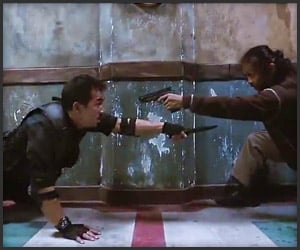
Hard Target – Director’s Cut (1993)


When the big Hong Kong craze started in America in the early 1990s (of course, Chinese cinema was popular beforehand, most prominently in the form of the martial arts movies of the 60s through the 80s, but still...), it was like getting punched in the teeth with a set of brass knuckles (not an experience I recommend, by the by). While there were plenty of people aware of the talent off to the East, getting your hands on the actual product was both difficult and costly. Nonetheless, once Hollywood producers realized there was money to be made with these filmmakers, they started courting them to work over here. Of course, the impending return to power of the Communist party and the fear this engendered was an added concern to Chinese natives at the time and helped said filmmakers make the decision to leap across the pond. Given budgets higher than anything they had in their homeland but still considered relatively low in America, it seemed like these skilled craftsmen were all saddled with one other hurdle to breaking through to the mainstream in this country. They all had to make at least one movie starring Jean-Claude Van Damme

At the time, Van Damme was at the height of his popularity, and I suppose the (kind of ignorant) idea was that since martial arts are usually thought of as Asian, and these filmmakers are Asian, and Van Damme knows martial arts, then pairing these filmmakers with this star should produce results unheralded in the realm of action films. The four most noticeable directors (at least to my knowledge) to wade into this territory (but not the only expats, to be sure) were Ringo Lam, Tsui Hark, Kirk Wong, and John Woo. Of these four, only Wong didn't work directly with the seeming clearing house for Asian directors that was the "Muscles From Brussels." Also of the four, only Woo maintained a successful (if checkered) career in America before returning to China for the phenomenal Red Cliff

Natasha "Nat" Binder (Yancy Butler) travels to New Orleans to find her father, Douglas (writer and co-producer, Chuck Pfarrer). Unfortunately, the ex-marine had fallen on hard times and become homeless. Emil Fouchon (Lance Henriksen) and Pick van Cleef (Arnold Vosloo), coincidentally, run a service wherein they accommodate the hunting and killing of homeless vets for the pleasure of rich scumbags. Needless to say, Binder was a recent player (and loser) in Fouchon's game. Natasha hires destitute sailor, Chance Boudreaux (Van Damme), to help her find her dad (who she, of course, does not know is already dead). But when Chance and Natasha start asking questions, Fouchon decides to set his sights on the pair and unleash the hounds.

Hard Target is a take on Richard Connell's short story, "The Most Dangerous Game," first published in 1924. The idea (and the genesis of the title) comes from the story's aristocratic General Zaroff who feels that man is the most dangerous game of all to hunt. It has been adapted numerous times with varying quality. In this go at the tale, Fouchon's mindset is clarified for the viewer in the piano scene. As Fouchon bangs away at the keys, he stares at his reflection in a mirror. Woo intercuts to stock footage of actual animals being hunted and shot in (I presume) Africa. It's effective as a look into Fouchon's mind, and it's done completely without dialogue. Whether these shots were cut out because of the difference in quality of the stock footage to what Woo shot or because of any objections to actual depictions of animals being killed on screen (which would be my suspicion, though had this film been made in Hong Kong I believe they probably would have been left in), I can't say, but I prefer this former version, as it gives our villain some depth.

The filmmakers also seem highly concerned with the plight of the homeless. Unfortunately, they labor the point and kind of get on a soapbox about it. There are a couple of extended dialogue scenes (including a love scene), where we're reminded repeatedly how it is out there, on the streets. It gets old fast. However, the homeless people depicted in the film are given a certain amount of respect, and we do get a feel for the pride they have to swallow (nay, beat down) to survive. Douglas Binder is depicted in this version as being more than just a disheveled, harried prey. In the credit sequence, he makes it to the river, and Fouchon's "dogs" slow him down at the pier shack. Binder grabs a gas can and rolls it at the hunters, who inexplicably shoot at it until it explodes. In other words, he's allowed a moment to stand up, to show just why Fouchon and company carry on these hunts with these prey in the first place. The theatrical version takes this part away, and Binder is shown as pretty much a terrified rabbit scurrying tragically for safety. 

Aside from the dialogue-heavy, exposition-laden (and repetitive) scenes which were mercifully trimmed to keep the pace up, the other noticeable changes occur in the action sequences. Woo, as a director of action, was without peer at the time. As a matter of fact, his knack for kinetic, clearly-blocked action holds strong to this day. In this early cut of the film, the action scenes are almost all longer, and here Woo's signature style really shows through. His use of zooms, juxtaposition of slow motion to realtime action, explosions with showers of sparks, freeze frame transitions, wide angle lens usage and fast tracking shots both against and with action are all in evidence. Having said that, these scenes could all use some tightening up, however why they were cut down the way they were is a mystery. Perhaps it was to hit a certain runtime for the film (this cut is one hour, fifty-seven minutes, whereas the theatrical version is one hour, thirty-seven minutes). Perhaps the American producers felt it was too much for an American audience to take in (I somehow doubt it). Either way, to me it's like hiring a chef renowned for the best beef dishes in the world and then telling him you want one of these dishes prepared by him but without using beef.

There are some other differences, of course. The Mardi Gras graveyard finale is edited differently, with more emphasis placed on the cat and mouse aspects of the situation. Here, Woo shows us shots of the ex-floats leering, teasing, while Chance speaks from among them and, predominantly, offscreen. It's an interesting take on how to play the scene, and it works better than the more traditionally cut theatrical version. Van Damme (or more likely his stunt double) seems to do a lot of flips and somersaults around the warehouse. Thankfully, these shots were mostly removed from the final cut, as they are just flat-out silly. And funnily, Fouchon's fate in this edit is not nearly as satisfying as the one in the studio version. Actually, it's fairly offhand and a tad anticlimactic. 

So, which is the better version of the two? It's a fine hair to split, but I would give it to this "director's cut." Even with the more ridiculous scenes still in it (surfing on the motorcycle, punching the rattler, etcetera, you know, the ones you love), you get more of what makes Woo's movies great. Had Universal focused on refining this version and trimming its fat, they could have had one of the great action movies of the decade. Instead, they got an okay one.

MVT: John Woo takes the credit on this film. This film is a diamond in the (very) rough, and you can see that the man wasn't just phoning it in on his first American effort.

Make Or Break: The credit sequence shows us, in just a few different instances, the higher quality of film that Hard Target should have been.

Score: 7.5/10

**Like this review?  Share it with a friend.  Hate it?  Share it with an enemy.**

Tuesday, March 20, 2012

Episode #176: Dirty Ho of Death

Welcome to another episode of the GGtMC!!!

This week the Gents cover Dirty Ho (1976) starring Gordon Liu and Wong Yue and Napoli Spara AKA Weapons of Death (1977) starring Leonard Mann and Henry Silva!!! Great conversation and many tangents were had on this show folks!!!

Direct download: DirtyHoofDeathRM.mp3

Emails to midnitecinema@gmail.com

Voicemails to 206-666-5207

Adios!!!